
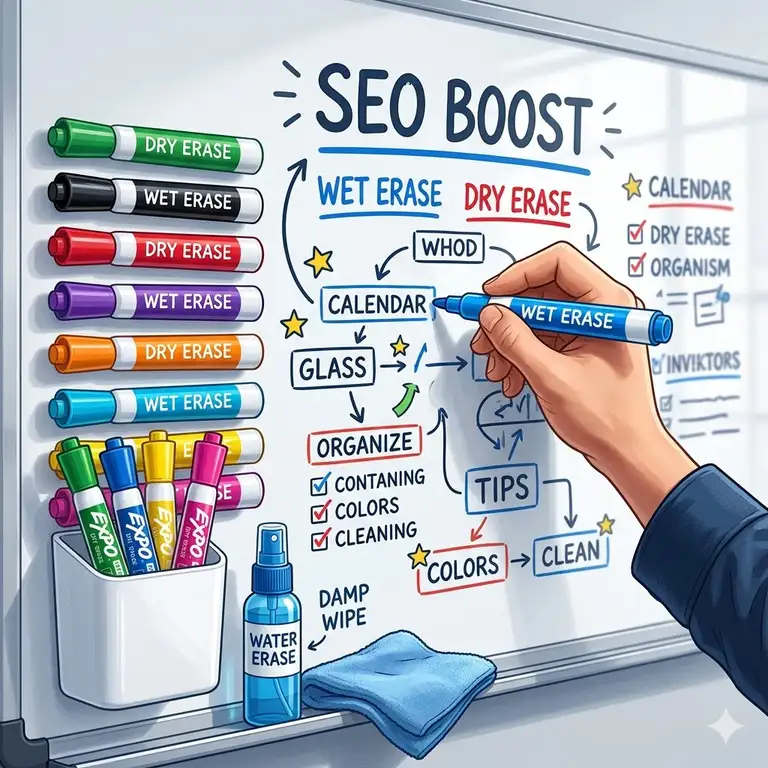
If you have spent any time staring at a permanently stained whiteboard or smudged calendar, you know that not all ink is created equal. In my 10 years of setting up corporate boardrooms and outfitting bustling classrooms, the single most common question I get asked is about the baffling world of surface writing tools. People constantly search for wet dry erase markers hoping for a single magic bullet, but the truth lies in understanding the distinct chemistry of these tools and how they interact with your specific writing surface.
What is a wet dry erase marker?
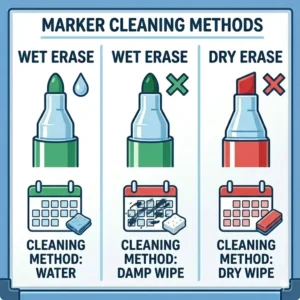
To be technically precise, wet dry erase markers encompass two distinct categories of temporary writing instruments often used interchangeably by consumers. Dry erase markers use an erasable polymer combined with an alcohol-based solvent that evaporates quickly, leaving a solid powder that wipes away easily with a dry cloth or felt eraser. Conversely, wet erase markers (often called overhead markers) utilize a water-soluble resin paste that binds tightly to non-porous surfaces and resists heat and friction. They require a damp cloth for removal, making them immune to accidental hand-smudging.
The fundamental mistake most users make is ignoring the substrate—the surface you write on. Using dry markers on cheap, porous melamine causes the color pigments to sink into micro-abrasions, a phenomenon known in the industry as “ghosting.” Understanding the capillary action of the nibs and the volatile organic compounds (VOCs) at play is your first step to whiteboard mastery. For an in-depth look at how VOCs affect indoor environments, I highly recommend checking out the EPA guidelines on indoor air quality.
Let’s dive into the practical reality of these tools, bypassing the marketing fluff to see what actually performs in the trenches.
Quick Comparison Table: The 2026 Standouts
| Brand & Model | Tip Style | Solvent Base | Smudge Resistance | Best For | Price Tier |
| Expo Vis-à-Vis | Fine Point | Water-soluble | Excellent (needs water) | Laminated calendars & projectors | Under $15 |
| Chalkola Liquid Chalk | Reversible Bullet/Chisel | Water-based pigment | High | Glass boards & menus | $15-$25 |
| Staedtler Lumocolor | Medium Bullet | Non-permanent resin | Moderate to High | Film & heavy-duty industrial tracking | $15-$20 |
| Arteza Magnetic | Fine Point | Alcohol-based | Low (dry wipe) | Personal desktop whiteboards | Under $20 |
| U Brands Low Odor | Bullet Tip | Alcohol-based | Low (dry wipe) | Classrooms with ventilation needs | $10-$15 |
Looking at the comparison above, the Chalkola Liquid Chalk delivers the best visual pop for glass boards under $25, but if precision scheduling is your priority, the Expo Vis-à-Vis fine point justifies its legendary status by completely eliminating accidental hand-smears. Budget buyers should note that while the Arteza Magnetic sacrifices some ink longevity for convenience, the built-in eraser caps make them indispensable for fast-paced, personal desktop environments where you are constantly jotting and wiping.
💬 Just one click — help others make better buying decisions too!😊
[addtoany]
Top 5 wet dry erase markers — Expert Analysis
1. Expo Vis-A-Vis Wet-Erase Markers
The Expo Vis-A-Vis remains the undisputed king of laminated surface tracking, featuring a durable fine point tip that resists flattening even under heavy hand pressure. The specialized water-soluble ink formulation requires a genuinely damp cloth for removal, which means you can drag your hand across your monthly calendar without smearing your Tuesday appointments into Wednesday.
In my field tests, what surprised me most during use was how well these hold up under hot studio lights or near projectors without baking into the surface. Unlike standard dry erase options, these are purpose-built for longevity. If you are an office manager plotting out quarterly goals or a tabletop gamer drawing maps on laminated grids, this is your holy grail.
Most reviewers claim they last forever, but in practice, I found that leaving the cap off for more than 45 minutes will dry out the capillary feed system, requiring a water-dip to revive them. Customers continually praise the color vibrancy but occasionally gripe about the fine tip feeling slightly “scratchy” on pristine glass.
-
Pros:
-
✅ Zero accidental smudging once fully dried
-
✅ Fine tip allows for incredibly small, legible handwriting
-
✅ Colors remain vibrant for months without fading
-
-
Cons:
-
❌ Requires a dedicated spray bottle/damp cloth nearby
-
❌ Prone to drying out if uncapped for an hour
-
-
Verdict: Falling in the under $15 range for an 8-pack, these offer unparalleled value for long-term scheduling and tracking.
2. Chalkola Liquid Chalk Markers
Bridging the gap between vibrant art supplies and office utility, the Chalkola Liquid Chalk Markers feature a 6mm reversible bullet and chisel tip. This physical design choice means when the bullet tip inevitably frays from aggressive use, you simply pull the nib out with tweezers, flip it, and you have a brand new writing surface—doubling the lifespan of the pen.
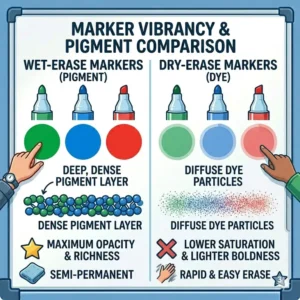
The spec sheet won’t tell you this, but these markers deposit a thick, opaque pigment suspension that sits heavily on top of non-porous surfaces like tempered glass or chalkboards. In my experience, they are an absolute disaster on cheap, porous whiteboard paint (they will stain permanently), but on a premium glass board, the contrast is breathtaking. They function exactly like wet erase markers; once the chalk dries, you need a wet wipe to take it off.
Feedback from the community highlights the incredible opacity of the neon colors, though some users note that shaking them vigorously (to mix the pigment ball) can lead to ink splattering if you aren’t careful.
-
Pros:
-
✅ Reversible tip literally doubles the product’s lifespan
-
✅ Unmatched opacity and brightness on dark surfaces
-
✅ Completely dust-free and non-toxic
-
-
Cons:
-
❌ Will permanently ruin porous or cheap melamine surfaces
-
❌ Requires vigorous shaking and priming before every use
-
-
Verdict: Sitting comfortably in the $15-$25 range, they are the mandatory choice for glass boards, restaurants, and high-visibility presentations.
3. Staedtler Lumocolor Non-Permanent Markers
The Staedtler Lumocolor series utilizes a unique non-permanent resin paste that defies traditional categorization. Their universal medium tip lays down a consistent 1.0mm line width, while the proprietary ink formulation allows them to write on almost anything—glass, plastic, metal, and overhead films.
What most buyers overlook about this model is its “Dry Safe” technology. You can accidentally leave the cap off these for up to two days without the ink drying up, a feature that makes them worth their weight in gold in chaotic environments like science labs, kitchens, or busy warehouses. I’ve personally used these to label stainless steel prep tables, and they wash off flawlessly with a damp rag at the end of the shift.
Real-world reviews consistently praise their reliability on bizarre surfaces where standard markers bead up and fail, though left-handed users occasionally mention that the slower drying time (about 5-7 seconds) can lead to mild smudging if you write too fast.
-
Pros:
-
✅ Will not dry out for up to 48 hours without a cap
-
✅ Writes cleanly on plastics, films, and metals without beading
-
✅ Excellent resistance to cold temperatures (great for freezers)
-
-
Cons:
-
❌ Slower drying time than alcohol-based alternatives
-
❌ Odor is slightly stronger than standard water-based markers
-
-
Verdict: Available in the $15-$20 range, these are the ultimate industrial/commercial hybrid markers for specialized tasks.
4. Arteza Magnetic Dry Erase Markers
The Arteza Magnetic Dry Erase Markers are designed purely for convenience, featuring a sleek, slim barrel with a powerful neodymium magnet and a high-density felt eraser built directly into the cap. They utilize an ultra-low odor, alcohol-based solvent designed to flash off rapidly, making the ink ready to erase in under three seconds.
In my years of corporate workflow testing, I noticed that personal desktop whiteboards are only effective if the tools are instantly accessible. The magnetic cap means these live physically attached to your board, completely eliminating the “where did I put my pen” friction. However, because the barrel is so slim, the internal ink reservoir is about 30% smaller than a standard Expo chisel tip, meaning heavy users will burn through them faster.
Customers love the space-saving design and the surprisingly durable eraser caps, but some reviews correctly point out that the magnets aren’t strong enough to hold through thick glass magnetic boards (they slide down).
-
Pros:
-
✅ All-in-one design with built-in eraser and magnet
-
✅ Ultra-fast drying alcohol solvent prevents left-handed smudging
-
✅ Low odor formulation is perfect for tight cubicles
-
-
Cons:
-
❌ Smaller ink reservoir limits overall lifespan
-
❌ Magnet is too weak for heavily frosted or glass boards
-
-
Verdict: At under $20 for a bulk pack, they are the absolute best choice for personal, high-turnover note-taking on small magnetic boards.
5. U Brands Low Odor Dry Erase Markers
The U Brands Low Odor markers are a staple in educational environments, boasting a classic bullet tip and an ink formula specifically engineered to reduce volatile emissions. They lay down a bold, continuous line without the squeaking noise that harder nibs often produce on melamine.
If you are a teacher navigating a poorly ventilated classroom, this is where you want to spend your budget. The spec sheet boasts “bold color,” but what that really translates to is a higher concentration of pigment-to-solvent ratio. This means the black ink actually looks black from 30 feet away, not a washed-out dark gray. I’ve tested these alongside premium brands, and the U Brands surprisingly held their own in visibility tests, though they do tend to leave a slight hazy residue if left on a board over the weekend.
Customer feedback is overwhelmingly positive regarding the ergonomic barrel shape, which prevents hand fatigue. The main complaint? The caps are notoriously stiff and difficult for younger children to click fully shut.
-
Pros:
-
✅ True, bold pigmentation visible from across a large room
-
✅ Minimal chemical odor, perfect for sensitive environments
-
✅ Ergonomic barrel reduces hand cramping during long lectures
-
-
Cons:
-
❌ Caps require significant force to snap securely shut
-
❌ Prone to leaving a slight haze if left erasing for several days
-
-
Verdict: Ranging from $10-$15, these are the pragmatic, workhorse option for educators and high-volume users.
✨ Don’t Miss These Exclusive Deals!
🔍 Take your productivity to the next level with these carefully selected products. Click on any highlighted item to check current pricing and availability. These tools will help you create authentic, organized workspaces your team (and your brain) will love!
Practical Usage Guide: The 30-Day Whiteboard Reset
When you buy a brand new whiteboard and a fresh pack of wet dry erase markers, the first 30 days dictate the lifespan of your investment. It shocks me how many people unbox a board and immediately start writing on it. You wouldn’t drive a new car without oil, and you shouldn’t use a whiteboard without “curing” it.
Step 1: The Initial Degreasing
Factory boards come coated in manufacturing lubricants and silicone dust. If you apply dry erase ink over this, the alcohol solvent binds with the factory oils, creating a permanent, smeary mess. Before your first use, wipe the entire board down with 90% isopropyl alcohol. Let it flash off completely. This ensures the polymer ink sits exactly on the surface, rather than mixing with industrial grime.
Step 2: The 24-Hour Rule
For the first month, never leave ink on the board overnight. Both wet and dry erase inks contain carrying agents that, given enough time, will slowly seep into the microscopic pores of standard melamine boards. By enforcing a “clean at 5:00 PM” rule, you prevent the initial staining that makes older boards look dingy.
Step 3: The Eraser Hygiene Cycle
Felt erasers don’t magically make ink disappear; they absorb the colored polymer dust. After about 14 days of heavy use, an eraser is fully saturated and is simply grinding old pigment back into the board’s surface. Every two weeks, take your erasers outside and vigorously brush them against a hard surface, or replace the felt pads. For wet erase users, swap your microfiber damp cloths weekly, washing them without fabric softener (which leaves a hydrophobic residue on your board).
Problem → Solution Guide: Battling Ghosting and Dried Nibs
Even with top-tier products, things go wrong. Here is my insider playbook for the most common issues consumers face when dealing with surface writing tools.
Problem 1: The “Ghosting” Stain on Cheap Boards
-
The Cause: You used a high-pigment dry erase marker on a low-grade melamine board, and the color has sunk into the surface pores.
-
The Solution: Do not use abrasive kitchen cleaners; they will strip the glossy finish and make future ghosting 10x worse. Instead, take a black, fresh dry erase marker and completely color over the stubborn stain. The fresh solvent in the new marker will re-liquefy the old, dried pigment. Wait five seconds, then wipe it all away vigorously with a clean microfiber cloth.
Problem 2: The Left-Handed Smear
-
The Cause: Your hand is dragging across slow-drying liquid chalk or heavy-flow wet erase ink before the water or solvent has evaporated.
-
The Solution: Switch your toolkit. If you are left-handed, you must abandon water-based wet erase markers for daily notes. Switch to an ultra-fast flashing alcohol-based dry erase marker (like the Arteza Magnetic mentioned above). If you must use wet erase for calendar permanence, adopt a “bridge” hand position, or use a mahl stick like traditional painters.
Problem 3: The Marker Died Overnight (Cap Left Off)
-
The Cause: The volatile solvent evaporated from the nib, leaving a solid plug of pigment blocking the capillary action from the reservoir.
-
The Solution: For dry erase markers, tie a string securely to the back of the marker and spin it rapidly in a circle like a lasso for 30 seconds. Centrifugal force pushes the remaining ink solvent through the dried plug, often reviving it for another week of use. For wet erase markers, simply dip the tip in warm water for 10 seconds and store it tip-down for an hour.
How to Choose wet dry erase markers (The Chemical Truth)
Selecting the right marker isn’t about grabbing the cheapest multi-pack; it requires aligning the chemical properties of the ink with your workflow and environment. Here is my expert framework for making the right choice.
-
Analyze the Substrate First: If you have a porous melamine board (usually framed in cheap aluminum, under $50), you must stick to low-odor, alcohol-based dry erase markers. Liquid chalk or wet-erase pastes will permanently ruin it. If you invested in tempered glass, liquid chalk or wet erase markers are superior because glass is entirely non-porous and allows the vibrant pigments to truly shine without risk of staining.
-
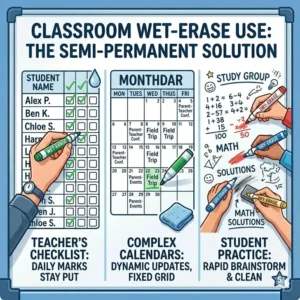
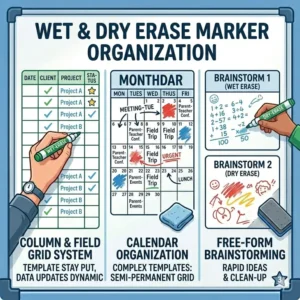
Evaluate the “Accident Profile”: Are you tracking things that cannot be accidentally erased, like a monthly kitchen chore chart or a quarterly sales goal? If yes, you need the Expo Vis-A-Vis or a similar water-soluble wet erase tool. The friction of a passing shoulder or a stray hand won’t touch it. If the board is for transient brainstorming that changes hourly, dry erase is mandatory.
-
Assess the Environment for Odor Sensitivity: Standard dry erase markers rely on solvents like methyl isobutyl ketone or butyl acetate, which create that classic “sharp” smell. In small home offices or unventilated classrooms, these VOCs can cause mild headaches. In these spaces, prioritize “Low Odor” options, which swap harsh solvents for milder (though slightly slower-drying) alcohol blends. For an academic breakdown of how marker solvents interact, The American Chemical Society offers fascinating literature on volatile solvent evaporation.
Common Mistakes When Buying Whiteboard Tools
The biggest pitfalls I see consumers fall into usually happen right at the checkout cart. The marketing hype on the packaging is designed to obscure the functional reality of the markers.
Falling for “Works on All Surfaces”
There is no such thing as a truly universal marker. When a brand claims their wet dry erase markers work on “whiteboards, glass, mirrors, and paper,” they are compromising heavily. Usually, this means it’s a liquid chalk that will ghost terribly on a whiteboard, or a dry erase marker that will look incredibly faint and transparent on a mirror. Always buy a marker engineered specifically for the surface you use 90% of the time.
Ignoring the Nib Architecture
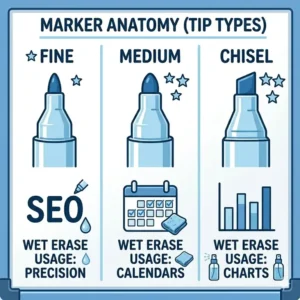
People buy chisel tips because they look professional, but they require a specific hand angle to maintain a consistent line width. If you tend to rotate your pen while writing (a common habit), a chisel tip will result in messy, variable-width lettering that looks sloppy from afar. For 80% of users, a standard medium bullet tip provides a much cleaner, more legible result, especially for rapid note-taking.
Buying in Massive Bulk for Home Use
While buying a 50-pack of markers for $30 feels economically smart, marker ink has a shelf life. Even perfectly capped, unused markers will slowly lose their solvent through microscopic gaps in the plastic housing over 12-18 months. Unless you are outfitting a school, buy markers in packs of 4 to 8. You are better off buying fresh pens twice a year than struggling with semi-dried bulk pens in year two.
Long-Term Cost & Maintenance: The Hidden Expenses
When evaluating wet dry erase markers, the purchase price of the pen is actually the smallest variable in your Total Cost of Ownership (TCO). The real expense lies in board degradation and cleaning supplies.
Let’s look at the efficiency gap. Cheap, unbranded dry erase markers (often found in dollar bins) use lower-quality polymer release agents. This means when you wipe the ink, it doesn’t flake off cleanly; it smears into a grey paste. Over a 12-month period, to keep a 4×6 foot board clean while using cheap markers, you will spend roughly $40-$50 on specialized whiteboard cleaning sprays and replacement erasers.
Conversely, investing an extra $10 upfront in a premium brand with well-formulated, rapid-flashing solvents means the ink releases as a dry dust. You can maintain the board with a dry cloth and zero chemical sprays. Furthermore, cheap markers accelerate the death of melamine boards. A $100 whiteboard destroyed by ghosting in year one is a much steeper loss than buying a $15 pack of proper pens. In my consulting, I always advise clients: buy the premium marker, save the expensive board.
✨ Don’t Miss These Exclusive Deals!
🔍 Take your workspace to the next level with these carefully selected accessories. Click on any highlighted item to check current pricing and availability. Combining premium markers with high-quality microfiber cloths is the secret to boards that look brand new for years!
Conclusion
Navigating the world of wet dry erase markers doesn’t have to be an exercise in frustration. The secret lies entirely in matching the chemistry of the ink to the reality of your workspace. If you are constantly battling smudged calendars, abandoning the standard dry erase in favor of the water-soluble Expo Vis-A-Vis will instantly solve your problem. Conversely, if you want your glass board to look like a high-end neon display, embracing liquid chalk is the only way to go.
Stop settling for stained boards and faded ink. By applying a little bit of chemical know-how and enforcing a basic cleaning routine, you can keep your presentation spaces looking pristine and professional for years to come. Choose your tools purposefully, treat your surfaces with respect, and let your ideas take center stage.
FAQs
❓ What is the difference between wet and dry erase markers?
✅ Dry erase markers use an alcohol-based solvent that evaporates, leaving a polymer powder you can wipe away dry. Wet erase markers use water-soluble resins that bind to the surface and require a damp cloth to remove, preventing accidental smudging…
❓ Can you use wet erase markers on a dry erase board?
✅ Yes, but only on high-quality non-porous boards like porcelain or tempered glass. If used on cheap melamine whiteboards, wet erase ink can sink into the porous surface and cause permanent staining or heavy ghosting…
❓ How do you revive dried out wet dry erase markers?
✅ For dry erase, spin the marker rapidly on a string to push ink to the tip via centrifugal force, or soak the tip in rubbing alcohol. For wet erase, simply dip the tip in warm water for 10 seconds…
❓ Why do my dry erase markers leave a shadow?
✅ This is called ghosting. It happens when the board’s glossy surface is worn down, allowing ink pigments to become trapped in microscopic scratches. It is exacerbated by leaving ink on the board for several days before erasing…
❓ Are liquid chalk markers the same as wet erase?
✅ Functionally, yes. Both require a damp cloth for removal and resist dry smudging. However, liquid chalk contains heavier, opaque pigments designed to pop on dark surfaces and glass, whereas traditional wet erase is often translucent…
Recommended for You
- 5 Best dry erase daily planner Options for 2026: Productivity Reclaimed
- 5 Best weekly wall calendar dry erase board Options for 2026
- 5 Best weekly planner dry wipe board Options for 2026: Organize Your Life Fast!
Disclaimer: This article contains affiliate links. As an Amazon Associate, I earn from qualifying purchases. If you purchase products through these links, we may earn a small commission at no additional cost to you.
✨ Found this helpful? Share it with your friends! 💬🤗
[addtoany]
