
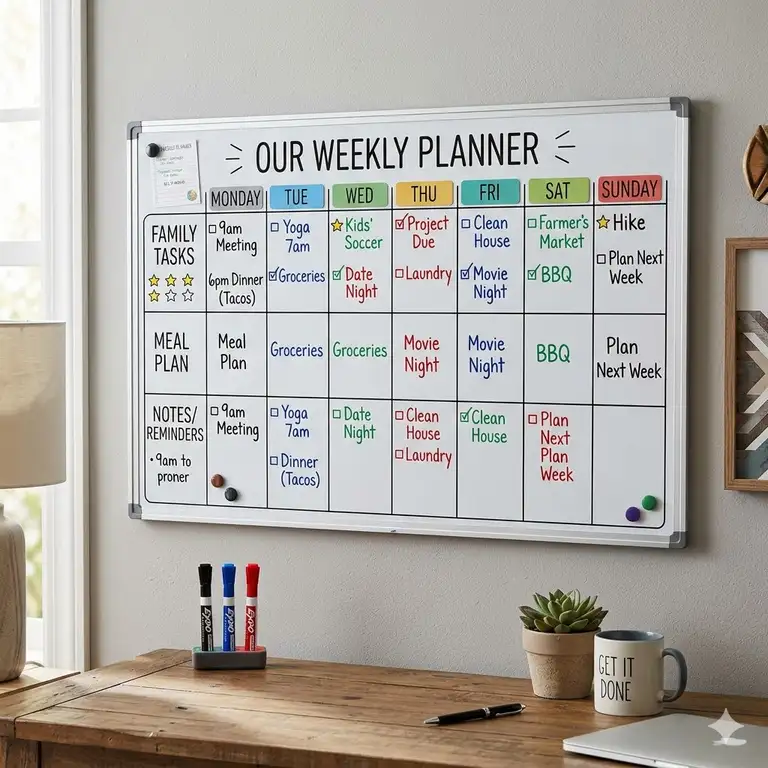
What is a weekly planner dry wipe board? A weekly planner dry wipe board is a reusable organizational tool featuring a pre-printed seven-day grid that allows users to write, erase, and update schedules using dry-erase markers. These boards are typically magnetic, allowing for the attachment of notes and memos, and serve as a central hub for time management in homes, offices, and classrooms.
In our hyper-digitized 2026 world, you might think the humble whiteboard has gone the way of the fax machine. But honestly? There is something visceral and undeniably effective about grabbing a marker and physically scratching a task off a list. It provides a dopamine hit that a smartphone notification simply cannot replicate. Whether you are managing a chaotic family schedule, tracking high-stakes deadlines at work, or just trying to remember which day is “taco Tuesday,” a high-quality weekly planner dry wipe board is the low-tech solution to high-tech burnout.
Expert organizers often suggest that visual persistence—the ability to see your schedule without unlocking a device—is the key to cognitive ease. By placing your week’s roadmap on a wall, you reduce the mental load required to remember appointments. It transitions your schedule from a hidden digital file to a shared household or office reality. This guide dives deep into the best options available today, focusing on durability, surface quality, and real-world utility.
Quick Comparison: Top weekly planner dry wipe board Picks
| Product | Surface Material | Magnetic? | Best For | Price Range |
| Maxtek Magnetic Weekly | Painted Steel | Yes | Home Office | Around $30 – $45 |
| Navaris Glass Planner | Tempered Glass | Yes | Modern Aesthetics | Around $55 – $75 |
| U Brands Contempo | Magnetic Steel | Yes | Small Spaces | Around $15 – $25 |
| DexBoard Pro Combo | Lacquered Steel | Yes | Heavy Duty Use | Around $40 – $60 |
| JILoffice Grid Board | Aluminum/Steel | Yes | Budget Professional | Around $25 – $40 |
Looking at the comparison above, the Navaris Glass Planner is the clear winner for those who prioritize a ghost-free surface and modern design, though it demands a higher investment. For the average user, the Maxtek Magnetic Weekly offers the best balance of size and functionality under $50. If you are tight on space, the U Brands Contempo provides a compact solution that doesn’t sacrifice magnetic strength.
💬 Just one click — help others make better buying decisions too! 😊
[addtoany]
Top 5 weekly planner dry wipe board Options: Expert Analysis
1. Maxtek Magnetic Weekly Planner Board (36″ x 24″)
The Maxtek Magnetic Weekly Planner Board is a powerhouse for anyone who needs a large-format view of their entire week without feeling cramped.
This board features a triple-layered lacquered surface designed specifically to resist “ghosting”—that annoying phenomenon where old marker ink leaves a permanent shadow. In my experience, boards of this size often suffer from warping, but the Maxtek uses a reinforced aluminum frame that keeps the surface perfectly flat even in humid environments. The 36″ x 24” dimensions mean each daily column is wide enough to fit more than just a single appointment; you can actually fit a full “to-do” list for every family member.
I recommend this for busy households or small project teams. What most buyers overlook is the mounting hardware; Maxtek includes a four-corner “fix-through” system which is significantly more stable than the “hanging eyelet” style found on cheaper boards. It won’t wiggle when you’re writing on Friday’s column.
Customer Feedback: Users frequently praise the smoothness of the surface, noting that even cheap markers wipe away clean after a full week of sitting. Some have mentioned the mounting template is helpful for DIY installation.
-
Pros: Large writing area, robust frame, high-quality mounting kit.
-
Cons: Might be too large for small apartments, requires two people for easiest installation.
Price Range: Around $35 – $48 (Check current price for 2026 deals).
2. Navaris Magnetic Glass Weekly Planner
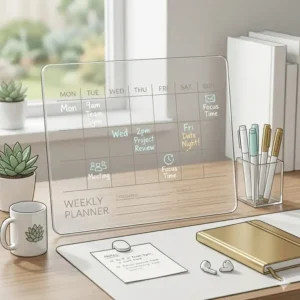
If you want your organization to look like a piece of modern art, the Navaris Magnetic Glass Weekly Planner is the premier choice.
Constructed from high-quality tempered glass, this board solves the longevity issue once and for all. Unlike painted steel, glass is non-porous, meaning ink literally cannot penetrate the surface. This board will look as new in 2030 as it does today. The “frameless” design offers a sleek, floating appearance on your wall that fits perfectly in a minimalist 2026 office aesthetic.
The expert take? You must use “neon” or high-contrast liquid chalk markers for the best visibility, as standard dry-erase markers can sometimes look faint against the glass background. Also, note that glass boards require “rare earth” (neodymium) magnets; standard kitchen magnets won’t be strong enough to hold through the thickness of the glass.
Customer Feedback: Buyers love the “executive” feel and the fact that it never stains. A common note is that the included magnets are strong, but you’ll want to buy an extra set if you plan on pinning many photos or receipts.
-
Pros: Zero ghosting ever, stunning aesthetic, extremely durable.
-
Cons: Heavy weight requires careful mounting, requires specific magnets.
Price Range: Around $55 – $75 (Premium value verdict: Best long-term ROI).
3. U Brands Contempo Magnetic Dry Erase Board
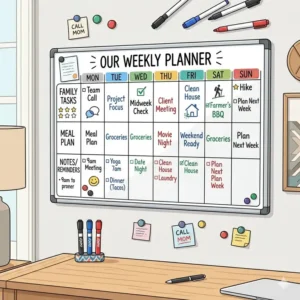
The U Brands Contempo Magnetic Dry Erase Board is the “goldilocks” solution for students or those with limited wall real estate.
This 11″ x 14″ board is compact but intelligently designed. The magnetic surface is surprisingly strong for its weight, and the modern curved frame adds a touch of style that doesn’t feel like a sterile office product. In my professional opinion, this is the best board for a “command center” inside a kitchen cabinet or on a bedroom door.
What the spec sheet won’t tell you is that the orientation is flexible. While pre-printed for weekly use, it works exceptionally well as a secondary board for tracking quick “sprints” or habit streaks. It is lightweight enough to be mounted with Command strips if you aren’t allowed to drill holes in your walls—a major plus for renters.
Customer Feedback: Most reviews highlight the portability and the quality of the included marker. A few users mentioned that the writing space is tight, so you’ll need fine-tip markers.
-
Pros: Budget-friendly, portable, renter-friendly mounting.
-
Cons: Limited space for detailed schedules, frame is plastic.
Price Range: Around $15 – $22 (Best budget choice for 2026).
4. DexBoard Magnetic Weekly/Monthly Combo
For those who suffer from “scheduling FOMO,” the DexBoard Magnetic Weekly/Monthly Combo offers a dual-view system that covers all bases.
This board isn’t just a weekly planner; it typically includes a larger monthly grid alongside a dedicated weekly section or a notes area. The surface is high-grade lacquered steel, which is magnetic and highly reflective. The specialized grid printing is baked into the surface, so it won’t rub off after repeated cleaning—a common failure point in “sticker-grid” alternatives.
This is best for project managers or freelancers who need to see the “Big Picture” (monthly) and the “Immediate Tasks” (weekly) simultaneously. The inclusion of a pen tray that slides along the bottom is a small but vital feature; it keeps your colored markers organized by priority (e.g., red for urgent, green for personal).
Customer Feedback: Users appreciate the “all-in-one” nature of the board. Some feedback suggests the monthly boxes are slightly small, but the weekly section compensates for the detail.
-
Pros: Multi-view planning, durable steel, integrated pen tray.
-
Cons: Complex visual layout can feel cluttered, larger footprint.
Price Range: Around $40 – $60 (Great for professional-grade organization).
5. JILoffice Weekly Magnetic Dry Erase Board
The JILoffice Weekly Magnetic Dry Erase Board is the utilitarian’s dream, focusing on high-visibility and ease of use.
Featuring a high-contrast black grid on a brilliant white background, this board is designed for readability from across the room. The aluminum frame is scratch-resistant, and the corners are rounded for safety—something to consider if you have kids running around. I find that JILoffice boards often have a slightly “grittier” surface than glass, which actually makes writing feel more controlled and less “slippery.”
Who is this for? The “no-nonsense” organizer. If you don’t care about glass aesthetics or combo grids and just want a reliable, easy-to-clean weekly planner dry wipe board that stays white, this is your pick. It provides excellent “cost-per-square-inch” value.
Customer Feedback: Reviewers often mention the “industrial” quality, stating it feels more like a school-grade board than a cheap home version. The packaging is also frequently cited as being very secure.
-
Pros: Excellent legibility, durable aluminum build, great value.
-
Cons: Very basic design, looks more “office-like” than “home-like.”
Price Range: Around $25 – $38 (Solid mid-range reliability).
✨ Don’t Miss These Exclusive Deals!
🔍 Take your organization to the next level with these carefully selected products. Click on any highlighted item to check current pricing and availability. These tools will help you create authentic productivity results your family will love!
Mastering Your Week: A Practical Usage Guide
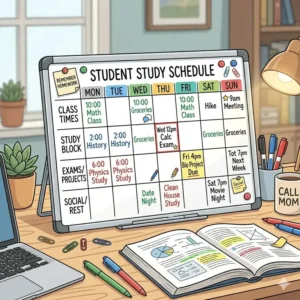
Buying a weekly planner dry wipe board is only half the battle; the real transformation happens when you integrate it into your daily flow. Most people treat their boards like a static decoration, but for it to be effective in 2026, it needs to be dynamic.
Step 1: The Sunday Reset
Every Sunday evening, spend 10 minutes clearing the previous week. This act of “wiping the slate clean” is psychologically powerful. It signals to your brain that the past is over and a fresh start is beginning.
Step 2: Color Coding for Cognitive Clarity
Don’t just use one black marker. Use a color-coding system that your brain can process at a glance:
-
Red: Non-negotiable deadlines or appointments.
-
Blue: Work-related tasks.
-
Green: Personal/Health (gym, meal prep).
-
Purple/Orange: Family or social events.
By using colors, you can look at the board from the hallway and immediately sense how “heavy” your work week is without even reading the words.
Step 3: The “Notes” Buffer
If your board has a blank space at the bottom or side, use it for “Next Week” items. This prevents your current weekly grid from becoming cluttered with things that don’t matter right now.
Maintenance Tip
To keep your surface pristine, avoid using paper towels, which can be abrasive. Instead, use a microfiber cloth. Once a month, use a dedicated whiteboard cleaner or a simple 70% isopropyl alcohol solution to strip away any accumulated “marker wax” that prevents smooth erasing.
Case Study: One Board, Two Worlds
How does a weekly planner dry wipe board perform in different environments? Let’s look at two common 2026 scenarios.
The Remote Executive (Home Office)
“Sarah” is a software consultant working from home. She uses the Navaris Glass Planner. For her, the board isn’t for every tiny task—it’s for “The Big Three.” Every morning, she writes down the three most important things she must achieve. Because the glass board is in her direct line of sight, it prevents “tab-switching” distraction. When she feels the urge to check social media, the board stares back at her, reminding her of her primary goal.
-
Result: 20% increase in deep-work productivity and less “end-of-day” anxiety.
The Busy Parent (The Command Center)
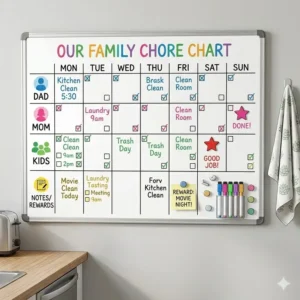
“Mark” has three kids and a rotating sports schedule. He uses the Maxtek 36″ x 24″ Board mounted in the kitchen. Each family member has a dedicated row within the weekly columns. By centralizing the “who-is-where” data, the family has eliminated the “I didn’t know practice was moved” arguments.
-
Result: Reduced household stress and a feeling of “shared responsibility” as the kids now check the board themselves instead of asking Dad every five minutes.
How to Choose the Right weekly planner dry wipe board
Selecting a board seems simple until you realize how many variables are at play. Use this framework to ensure you don’t end up with a “ghosting” nightmare.
1. Surface Material is King
-
Melamine: Budget-friendly but prone to staining over time. Only choose this for very light use.
-
Painted/Lacquered Steel: The standard choice. It’s magnetic and resists ghosting well if cleaned regularly.
-
Porcelain: Very durable and hard to scratch, but expensive and heavy.
-
Tempered Glass: The “Gold Standard.” It never stains, never ghosts, and looks incredible, though it requires stronger magnets.
2. Size vs. Writing Density
Measure your wall space before buying. A 12×18 inch board sounds large until you realize a single “Dr. Appointment” entry takes up 20% of a daily box. If you have a large handwriting style or a busy family, never go smaller than 24×36 inches.
3. Magnetic Capability
In 2026, a non-magnetic board is a missed opportunity. Being able to clip a physical invitation, a coupon, or a bill to the day it’s relevant is a game-changer. Ensure the board you choose uses a steel backing, not just a thin metallic film.
4. Mounting Options
Does it come with a tray? Can it be mounted vertically or horizontally? If you are in a dorm or rental, look for boards that are compatible with adhesive strips. If you are mounting on drywall, ensure the kit includes anchors.
Common Mistakes When Buying a weekly planner dry wipe board
Even savvy shoppers fall into these traps. Avoid them to save your sanity (and your wall).
The “Standard Magnet” Trap
Many people buy a beautiful glass weekly planner dry wipe board and are frustrated when their favorite souvenir magnets slide right off. Glass is thick. You must use Neodymium (rare earth) magnets. Don’t blame the board; blame the physics!
Ignoring the “Ghosting” Reviews
If multiple reviews mention that the board is hard to clean after 24 hours, listen to them. Cheaper boards use a thin plastic film that absorbs ink. You want a “non-porous” surface. Paying $10 more now saves you from replacing the board in six months.
Over-Complicating the Grid
Some boards have 50 different boxes for “water intake,” “mood,” and “daily goals.” While this looks cool, it often leads to “planner fatigue.” If the board is too hard to fill out, you won’t use it. Start with a clean, simple weekly grid and add your own complexity with markers as needed.
Glass vs. Steel: The Real-World Performance Breakdown
Is glass actually worth the extra $30? Let’s look at the data. Steel boards are fantastic for 2-3 years of heavy use. However, even the best lacquered steel will eventually develop microscopic scratches from cleaning. These scratches hold onto pigment, leading to that “cloudy” look.
Glass, being much harder than steel or plastic, does not scratch from standard use. It also allows for a “wet-erase” experience that is much crisper. If you are a “power user” who updates the board multiple times a day, glass is a no-brainer. If you just need a place to write “Milk, Eggs, Bread” once a week, steel is perfectly sufficient.
“In my experience, once you go glass, you never go back. The ease of cleaning is simply unmatched.” — Expert Organizer Insight.

Long-Term Cost & Maintenance
A $40 weekly planner dry wipe board should last you a decade if treated correctly. The total cost of ownership is remarkably low—about $4 per year. Compare that to a $25 paper planner you have to buy every single January!
The “Marker Maintenance” Secret
Believe it or not, the quality of your markers matters more than the board. Cheap, generic markers often use a more acidic ink that can eat into the finish of cheaper boards. I always recommend spending the extra $5 on name-brand low-odor markers.
Saving a “Ruined” Board
If someone accidentally uses a permanent marker on your board, don’t panic. Simply scribble over the permanent ink with a dry-erase marker. The solvents in the dry-erase ink will dissolve the permanent ink, allowing you to wipe both away. This “magic” trick has saved many office boards from the trash!
Features That Actually Matter (And Those That Don’t)
Marketing hype will tell you that you need “UV-Resistant Coating” or “Anti-Glare Nanotechnology.” Here is what actually matters in 2026:
-
Matters: Frame Rigidity. A floppy frame means the board will bounce every time you touch it, making your handwriting look like a 5-year-old’s.
-
Matters: Grid Permanence. Is the grid printed under the surface or on it? If it’s on top, it will fade.
-
Doesn’t Matter: Included “Free” Markers. Most markers included with boards are of mid-to-low quality. Buy your own high-quality set.
-
Doesn’t Matter: Decorative Borders. They look nice in photos but eat up valuable writing space. Every inch counts!
Why a Physical Board Beats a Digital App in 2026
We are surrounded by screens. Our phones are distractions masquerading as tools. When you look at a weekly planner dry wipe board, there are no “DMs,” no “breaking news” alerts, and no “low battery” warnings.
The physical board acts as a Commitment Device. When you write something down in public view, you are more likely to follow through. It’s a social contract with yourself and your household. Furthermore, “Spatial Memory” helps you remember things better; you don’t just remember what the appointment is, you remember where on the wall you wrote it. This creates a stronger neural pathway for memory.
✨ Don’t Miss These Exclusive Deals!
🔍 Take your organization to the next level with these carefully selected products. Click on any highlighted item to check current pricing and availability. These tools will help you create authentic productivity results your family will love!

Conclusion
Finding the right weekly planner dry wipe board is about matching your specific lifestyle to the right surface material and size. Whether you choose the sleek longevity of glass or the practical versatility of a large magnetic steel board, the goal remains the same: clarity. In an age of digital noise, a physical planner is your sanctuary of order. By centralizing your week’s goals and appointments, you reclaim your time and reduce the mental friction of daily life. Don’t just plan your week—visualize it, own it, and then erase it to start again even better.
FAQs
❓ How do I remove “ghosting” from my weekly planner dry wipe board?
✅ Use a microfiber cloth dampened with 70% isopropyl alcohol or a dedicated whiteboard restorer. For stubborn stains, the “dry-erase marker over permanent ink” trick usually works by re-solvating the old pigment…
❓ Can I use liquid chalk markers on a standard white board?
✅ Generally, no. Liquid chalk is designed for non-porous surfaces like glass or chalkboards. On a standard melamine or steel board, it may “shadow” or become very difficult to erase without heavy scrubbing…
❓ What is the best height to mount a weekly planner dry wipe board?
✅ The center of the board should be at eye level (roughly 58-60 inches from the floor) for the primary user. This prevents neck strain and makes the bottom rows easy to reach for writing…
❓ Are glass dry-erase boards magnetic?
✅ Only if they have a steel backing. Most modern glass planners, like the Navaris model, are “magnetic-compatible” but require extra-strong Neodymium magnets to function through the glass layer…
❓ How often should I replace my dry-erase markers?
✅ Markers should be replaced as soon as the tip frays or the color fades. Using “dried-out” markers can actually scratch the surface of cheaper boards if you press too hard to get ink out…
Recommended for You
- Dry Wipe Weekly Planner: 7 Best Boards to Smash Your Goals in 2026
- 7 Best Dry Erase Weekly Planner Options to Crush Your 2026 Goals
- Dry Erase Daily Schedule: 7 Best Boards to Boost Your 2026 Productivity
Disclaimer: This article contains affiliate links. As an Amazon Associate, I earn from qualifying purchases. If you purchase products through these links, we may earn a small commission at no additional cost to you.
✨ Found this helpful? Share it with your friends! 💬🤗
[addtoany]
