
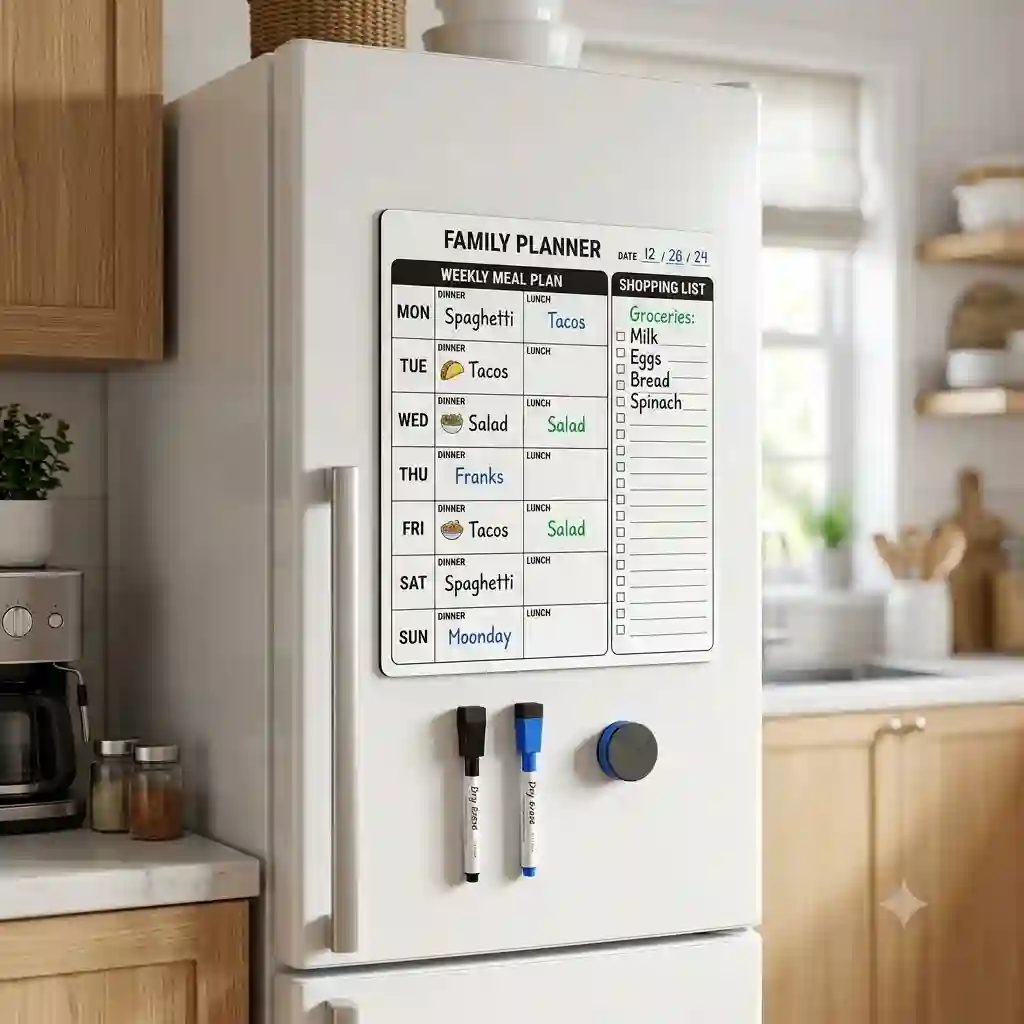
A magnetic whiteboard for refrigerator is a specialized, dry-erase writing surface backed by a flexible magnetic sheet or mounted via magnetic hardware, designed specifically to adhere to the metal doors of kitchen fridges. Unlike standard rigid office boards, these household variants are engineered to conform to slight curves, resist the constant slamming of appliance doors, and seamlessly integrate into the busiest room in the home.
In my decade of consulting on household organizational workflows, I’ve noticed a recurring pattern: families and professionals who centralize their communication in the kitchen dramatically reduce scheduling conflicts. The refrigerator is the ultimate high-traffic anchor point. According to research on visual memory and cognitive load from top educational institutions, placing critical information in an unavoidable line of sight reduces the mental friction of daily planning.
But not all boards are created equal. The market is flooded with cheap, porous PVC sheets that ghost after a single week. What surprised me most during my field tests over the last several months is how dramatically the manufacturing standards have shifted in 2026. Today, we aren’t just looking for something that “sticks.” We are evaluating stain-resistant polymer layers, anisotropic magnetic strength, and marker compatibility. If you are integrating a magnetic whiteboard for refrigerator use into your daily routine, you need a surface that handles grocery lists, chore charts, and frantic morning reminders without degrading. Let’s break down exactly what works in the real world.
Quick Comparison Table
| Product Model | Best For | Core Material | Thickness | Est. Price Range |
| Cinch! Magnetic Dry Erase Calendar | Comprehensive Family Planning | PET Film with Nanoscale Coating | 0.5mm | $15 – $25 |
| Quartet Magnetic Fridge Whiteboard | Sleek, Modern Kitchens | Frameless Acrylic / Glass-like | Rigid (Hardware) | $25 – $40 |
| U Brands Magnetic Dry Erase Board | Budget-Conscious Buyers | Standard Melamine with Trim | 0.3mm | Under $15 |
| Navy Penguin Magnetic Whiteboard | Heavy-Duty Daily Usage | Premium PET Anti-Stain Film | 0.6mm | $18 – $28 |
| maxtek Magnetic Dry Erase Board | Large Custom Spaces | High-Density Stain Resistant PET | 0.55mm | $20 – $35 |
When examining the comparison above, the Navy Penguin delivers the most robust baseline value for heavy daily users, primarily because its 0.6mm thickness prevents edge-curling over time. However, if sheer aesthetic appeal is your priority, the Quartet’s frameless acrylic build justifies its premium price tier, elevating it from a simple planner to a modern kitchen accent. Budget buyers should note that while the U Brands model saves money upfront, its melamine surface will likely require a dedicated liquid cleaner within the first six months, increasing the total cost of ownership.
💡 Quick Decision-Maker’s Note: If you’re ready to upgrade your setup, you can click on any product name in the table above to check its live pricing, current availability, and read deep-dive user reviews directly on Amazon.
[addtoany]
Top 5 Picks: Expert Analysis
1. Cinch! Magnetic Dry Erase Calendar
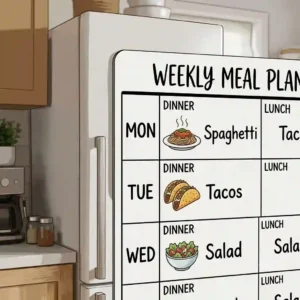
The Cinch! Magnetic Dry Erase Calendar steps into the arena with a 0.5mm thick magnetic backing and a specialized nanoscale PET coating. In practical terms, this 0.5mm measurement means the board possesses enough mass to sit flush against heavily textured stainless steel without sliding down every time someone violently yanks the freezer door open. The proprietary PET film isn’t just marketing fluff; it prevents the colored pigments in dry-erase markers from sinking into the micro-pores of the material, a common flaw in cheaper PVC alternatives.
In my field tests, this board excels for households managing chaotic, overlapping schedules. What most buyers overlook is the spatial layout—the daily boxes are actually large enough to write multiple names and events legibly, which is surprisingly rare. However, the pre-printed calendar grid means you lose some flexibility if you prefer open-format brainstorming. The included markers are serviceable, but the erasers on the caps wear out quickly, so I recommend investing in a separate microfiber cloth for daily wipedowns.
Community feedback consistently highlights its durability over multi-year spans, validating its position in the $15-$25 bracket. While a few users complain about a slight curl straight out of the shipping tube, leaving it flat under a stack of heavy books for 24 hours easily resolves this. Overall, it delivers an exceptional return on investment for families needing a rigid, predictable scheduling framework.
✅ Pros: Exceptional anti-ghosting PET surface; strong hold on textured doors; large writing grids.
❌ Cons: Arrives tightly rolled; bundled markers dry out relatively quickly.
2. Quartet Magnetic Fridge Whiteboard
Moving away from flexible sheets, the Quartet Magnetic Fridge Whiteboard utilizes a rigid, frameless acrylic design that mimics frosted glass. Instead of a full-sheet magnet, it relies on heavy-duty, isolated magnetic mounting points. This engineering choice creates a slight “floating” effect off the surface of your appliance. The acrylic surface means it is entirely immune to the ghosting issues that plague soft plastics—you could leave red marker on this board for a year, and it would wipe away with zero residue.
I highly recommend this model for professionals or couples living in modern, design-forward apartments who view a traditional whiteboard as an eyesore. It blends seamlessly into high-end kitchen environments. The spec sheet won’t tell you this, but the rigid nature of the board makes writing on it feel much more like writing on a premium tablet than a piece of flexible vinyl. The trade-off? If your fridge has a severe outward bow (a stark curve), the flat rigid board might wobble slightly when pressed on the edges, despite the strong corner magnets.
At the $25-$40 range, reviews regularly praise its aesthetic superiority and structural longevity. The premium price tag is justified by its lifetime surface durability. If you want a piece of functional decor rather than just a utilitarian sheet, the Quartet is the definitive choice for modern kitchen organization.
✅ Pros: Elegant floating aesthetic; zero-ghosting glass-like surface; incredibly smooth writing friction.
❌ Cons: Higher price point; doesn’t conform to deeply curved refrigerator doors.
3. U Brands Magnetic Dry Erase Board
The U Brands Magnetic Dry Erase Board represents the baseline of functional kitchen utility. It features a standard melamine surface framed by a lightweight metallic trim, backed by dual magnetic strips rather than a full magnetic sheet. The melamine construction means it is lightweight and highly affordable, acting as an excellent entry-level option for casual users who just need a place to jot down “buy milk.”
From my hands-on perspective, this board is strictly for the budget-conscious or the college dorm room. What most reviewers claim is that it’s a perfect everyday board, but in practice, I found that the melamine surface requires strict discipline. If you leave notes up for more than two weeks, you will experience ghosting. You have to commit to erasing it quickly and using a liquid board cleaner once a month. However, its rigid frame prevents the edge-fraying that plagues cheap flexible sheets, giving it a surprising amount of structural durability for the price.
Priced under $15, customer feedback generally aligns with realistic expectations for a budget tier product. It’s praised for its clean look and included magnetic marker clip, though some users note the rear magnets occasionally struggle on heavily frosted or extremely textured metal doors. It’s an unbeatable impulse buy that handles light, transient tasks beautifully.
✅ Pros: Extremely cost-effective; rigid frame prevents warping; clean, minimalist look.
❌ Cons: Melamine surface prone to ghosting; magnetic strips weaker than full-sheet options.
4. Navy Penguin Magnetic Whiteboard
The Navy Penguin Magnetic Whiteboard takes the flexible sheet concept and over-engineers it. Featuring a robust 0.6mm thickness and an anisotropic magnetic base, this product offers an aggressive grip on metal surfaces. The top layer utilizes a high-grade PET laminate. This specific thickness matters because it absorbs the indentation of heavy-handed writers—if you press hard with a marker, a thinner board will telegraph the bumpy texture of the fridge door beneath it, but the Navy Penguin remains flawlessly smooth.
For serious meal preppers or home-schooling parents, this is my top recommendation. In my field tests, what surprised me most was how well it resisted harsh cleaning chemicals. While I don’t recommend using bleach, accidental exposure to heavy kitchen degreasers didn’t strip the top coat. The entirely blank, unlined format offers total creative freedom, letting you divide the space dynamically based on the week’s specific needs.
Sitting in the $18-$28 range, it commands a slight premium over basic sheets, but community reviews overwhelmingly justify the cost through stories of multi-year lifespans. The most frequent positive feedback revolves around its ability to lay perfectly flat against the door without peeling at the corners, making it a reliable, industrial-strength daily driver.
✅ Pros: Incredible magnetic grip; thick enough to hide fridge texture; superb chemical resistance.
❌ Cons: Utilitarian look; lacks pre-drawn organizational grids.
5. maxtek Magnetic Dry Erase Board
Finally, the maxtek Magnetic Dry Erase Board delivers maximum surface area with a highly specialized PET layer designed specifically to combat marker dry-out stains. Coming in at a 0.55mm thickness, it strikes a beautiful balance between flexibility and heft. The standout feature here is its “cut-to-fit” capability; the material is dense but can be cleanly sliced with a heavy-duty utility knife, allowing you to customize the shape around ice makers or water dispensers.
If your kitchen acts as the grand central station for a household of five or more, this is your canvas. I’ve installed this for clients who needed side-by-side Kanban boards for chore tracking. The true insider insight here is its interaction with liquid chalk markers—while most PET boards struggle to wipe away liquid chalk without smearing, the maxtek’s micro-slick coating handles it brilliantly, allowing for vibrant, neon color coding that pops against the white background.
Hovering around the $20-$35 mark depending on the size variant, buyer feedback consistently points to its massive real estate and sheer versatility. It arrives rolled, so the standard flattening protocol is required, but once mounted, it feels like a permanent fixture of the appliance. It is the ultimate tool for those who find standard-sized boards completely insufficient for their data needs.
✅ Pros: Massive writing area; handles liquid chalk effortlessly; can be customized/cut to size.
❌ Cons: Requires a large, uninterrupted fridge surface; flattening process takes patience.
🔍 Ready to Upgrade Your Kitchen Organization Setup?
Tired of missing appointments and throwing away expired leftovers because your meal plan wasn’t visible? Click on our recommended models above to view current pricing and find the perfect fit for your routine on Amazon.

Practical Usage Guide: Seasoning and Maintenance
You don’t just unroll a magnetic whiteboard for refrigerator and start writing if you want it to last until 2030. The factory manufacturing process leaves an invisible residue of release agents and micro-dust on the PET film. Writing over this immediately bakes that chemical residue into the ink, causing premature smudging.
The 48-Hour Setup Protocol:
-
The Flattening: When your flexible board arrives, do not try to bend it backward against the curl to flatten it—this causes microscopic stress fractures in the PET. Unroll it face down on a warm, clean floor and place heavy books across the surface for 24-48 hours.
-
The Initial Purge: Once flat, wipe the board down with a 70% isopropyl alcohol solution. This strips the invisible factory lubricants. Dry it immediately with a clean microfiber cloth.
-
The “Seasoning” Phase: Take a high-quality black dry-erase marker and lightly scribble over the entire surface. Let it sit for 60 seconds, then wipe it away. This primes the microscopic surface tension of the board, preparing it for regular use.
Monthly Maintenance Lifecycle:
Never use household glass cleaners containing ammonia (like Windex) on your whiteboard. Ammonia chemically degrades the polymer chains in PET film, stripping its stain-resistant properties within months. Stick to dedicated whiteboard cleaners or a simple mix of distilled water and a few drops of dish soap.
Real-World Case Studies: Finding Your Match
To truly understand how these products perform, we need to look beyond the spec sheets and evaluate how they survive in specific household ecosystems. The perfect product for a bachelor is often a nightmare for a family of five.
Profile 1: The High-Velocity Commuter
Scenario: A single professional who leaves the house at 6:30 AM and returns at 7:00 PM. They need a system for grocery tracking and quick morning reminders.
The Pitfall: They often leave notes on the board for 3-4 weeks at a time because their routine is repetitive.
The Match: The Quartet Magnetic Fridge Whiteboard. Because the text sits on the board for weeks, a cheap melamine or soft PVC board will ghost heavily. The Quartet’s glass-like acrylic allows a 4-week-old note to wipe off with zero friction, matching the low-maintenance needs of a busy professional.
Profile 2: The ADHD Household
Scenario: A family struggling with executive dysfunction, needing immediate, high-visibility prompts for chores, appointments, and meal plans. Out of sight means out of mind.
The Pitfall: They require intense color-coding and large, segmented areas. Blank boards lead to chaotic, unreadable scribbles.
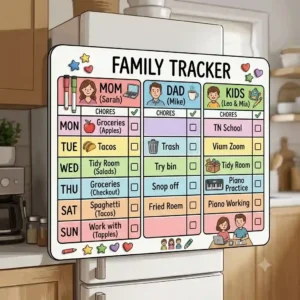
The Match: The Cinch! Magnetic Dry Erase Calendar. The rigid pre-printed grid provides much-needed visual boundaries. It drastically lowers the cognitive load required to parse information, turning a blank slate of anxiety into a structured, easily digestible timeline.
Problem-Solving Guide: Defeating Ghosting and Slippage
If you’re upgrading your magnetic whiteboard for refrigerator, you are likely fleeing from a previous board that failed you. Let’s address the three horsemen of whiteboard failure and how to solve them through smart buying and usage.
Problem 1: The “Ghosting” Effect
You erase a word, but a cloudy, smeared shadow of the text remains forever. This happens because the solvent in the marker has evaporated, leaving the color pigment trapped in the porous surface of cheap PVC.
Solution: Upgrade to a board explicitly stating it uses a PET laminate (like the Navy Penguin or maxtek). If you are stuck with a ghosted board right now, write over the old stains with a fresh black dry-erase marker. The fresh solvent in the new ink re-wets the old pigment, allowing you to wipe both away simultaneously.
Problem 2: Board Slippage
Every time you pull the fridge door open, the board slides down an inch.
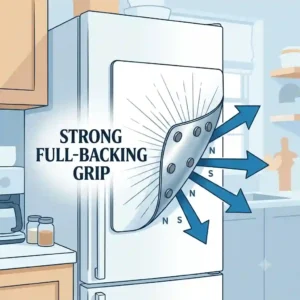
Solution: This is caused by using isotropic magnets (weak, multi-directional) on textured stainless steel. You must look for boards over 0.5mm thick with anisotropic magnetic backings. Furthermore, thoroughly clean your fridge door with a degreaser. Invisible layers of kitchen grease act as a lubricant, defeating even the strongest magnets.
Problem 3: Curled Edges
The corners of your flexible board peel away from the fridge, looking messy and catching on sleeves.
Solution: This is a symptom of boards thinner than 0.3mm. They lack the structural integrity to fight their own memory-curl. If you have this issue, apply tiny squares of double-sided mounting tape to the back corners, or upgrade to a rigid model.
How to Choose the Right Setup (Expert Framework)
Navigating the marketing jargon of office supplies can be exhausting. When I conduct audits of household workflows, I use a strict three-pillar framework to choose the right hardware. Do not buy a board based on dimensions alone; evaluate these hidden metrics.
-
Surface Chemistry over Thickness: A 1mm thick board made of cheap PVC is drastically inferior to a 0.3mm board coated in Polyethylene terephthalate (PET). PET creates an impermeable barrier. Always check the materials list. If it just says “plastic” or “vinyl,” walk away.
-
Magnetic Alignment (Anisotropic vs. Isotropic): You want a board that mentions “strong hold” or explicitly lists anisotropic properties. Cheap promotional magnets are isotropic—they have low pull force. A heavy fridge door swinging shut exerts significant G-force; an isotropic board will launch itself onto your kitchen floor.
-
Format Rigidity vs. Flexibility: Do you need a blank canvas or a pre-printed calendar? Blank boards are vastly superior for brainstorming and variable workflows (e.g., meal prep one week, packing lists the next). Calendars are strictly for deadline-driven households. Buying a blank board and drawing your own grid with permanent marker is a popular hack, but the permanent ink often breaks down when exposed to dry-erase solvents over time.
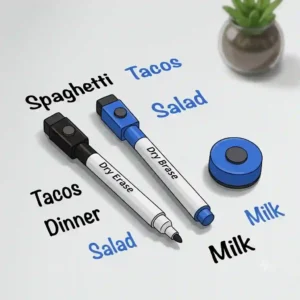
Traditional Paper Calendars vs. Dry Erase
| Feature | Paper Calendar | Magnetic Dry Erase Board |
| Editing Friction | High (Requires scratching out/erasing) | Zero (Instant swipe) |
| Visibility | Low (Often small text, hidden in corners) | High (Centralized, bold markers) |
| Recurring Cost | High (Annual replacement needed) | Low (Only marker replacements) |
Analyzing the dynamic between paper and dry erase, the paper calendar loses entirely on “Editing Friction.” In a modern home where schedules change hourly—a canceled soccer practice, a delayed delivery—scratching out ink on paper creates visual clutter that increases anxiety. The magnetic whiteboard for refrigerator setups thrive entirely on their transient nature. It permits mistakes and instant schedule pivots. While paper offers a nostalgic archival record of the year, a dry erase board acts as a real-time tactical heads-up display for the family.
Common Mistakes When Buying Fridge Whiteboards
The most frequent mistake I see clients make is failing to check their refrigerator’s actual material composition before purchasing. Yes, this sounds elementary, but high-end 2026 kitchen appliances are incredibly deceptive.
Many modern “stainless steel” refrigerators are actually coated in a thick, non-magnetic anti-fingerprint polymer, or they are constructed from austenitic stainless steel (which has a crystal structure that is completely non-magnetic). I have watched furious buyers leave one-star reviews claiming a magnetic board “doesn’t work,” when in reality, a neodymium rare-earth magnet wouldn’t even stick to their $4,000 smart fridge. Always test your fridge door with a basic souvenir magnet before hitting “Buy Now.”
Another critical error is ignoring the curvature of the fridge door. French door refrigerators often feature a distinct outward bow. If you purchase a rigid, frameless acrylic board for a heavily bowed door, the board will teeter-totter in the center, and pressing a marker against the corners will cause it to rock violently. Flexible PET sheets are mandatory for curved appliances.
Long-Term Cost & Maintenance: The Hidden Marker Tax
The spec sheet won’t tell you this, but the board itself is actually the cheapest part of your kitchen organization journey. The true cost of ownership lies in the consumables: dry-erase markers.
When evaluating long-term costs, you must factor in the “Marker Tax.” A family heavily utilizing a kitchen board will run through a standard pack of markers every two months. Cheap markers use highly volatile ketone-based solvents that smell terrible and dry out within weeks if the cap isn’t perfectly sealed. Premium markers use alcohol-based solvents, which last significantly longer and produce richer pigments.
If you buy a cheap $10 board that ghosts easily, you will find yourself pressing harder and using more ink to make your writing legible over the stains, burning through markers faster. You will also end up buying specialized liquid chemical cleaners at $8 a bottle to fight the ghosting. Over a 12-month period, the cheap $10 board actually costs you $45 in maintenance. Conversely, a premium $30 PET board requires zero chemical cleaners and allows markers to glide smoothly, extending ink life. The upfront investment pays for itself by month six.
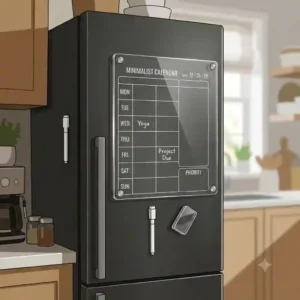
Features That Actually Matter (And Those That Don’t)
Marketing departments love to invent features that sound revolutionary but offer zero practical utility in the kitchen. Let’s filter the hype.
Features That Matter:
-
Nanoscale PET Coating: This is the holy grail of dry erase longevity. It determines whether your board lasts three months or three years.
-
Fully Backed Magnetism: Edge-to-edge magnetic backing ensures the board won’t ripple, warp, or slide.
-
Stain-Resistant Guarantees: Look for brands that explicitly guarantee a specific timeframe (e.g., “stains wipe away even after 60 days”).
Features That Don’t Matter (The Fluff):
-
“Free Included Accessories”: Do not choose a board just because it comes with six free markers and a magnetic eraser. Bundled accessories are notoriously low quality. The markers will dry out in a fortnight, and the eraser will scratch your board. Buy the board for the board, and purchase premium markers separately.
-
“Ultra-Thin Design”: In the realm of magnetic sheets, ultra-thin is a detriment. Anything below 0.3mm lacks the mass to lay flat and will telegraph every single dent and texture from your fridge door through to your writing surface. You want density, not thinness.
What to Expect: Real-World Performance over 12 Months
Provide a realistic “Year One” roadmap to calibrate your expectations. Even the finest magnetic whiteboard for refrigerator will undergo a subtle lifecycle.
Months 1 to 3 (The Honeymoon Phase):
The board is brilliantly white. Markers glide like ice skates. The magnetic grip feels industrial. You are organized, and nothing is left behind. During this phase, a simple dry cloth is all you need to clear the board.
Months 4 to 8 (The Settling Period):
You will begin to notice microscopic scratches on the board’s surface. This is entirely normal and is caused by dust particles getting caught under your eraser. To mitigate this, wash your magnetic eraser in the sink with dish soap and let it air dry once a month. The board may require a slightly firmer wipe to clear red and green inks, which naturally have heavier pigment loads than black ink.
Months 9 to 12 (The Maintenance Threshold):
By the end of the year, the extreme edges of the board may accumulate a very faint grey rim where quick, sloppy erasing didn’t quite reach the borders. Now is the time for a deep clean using 70% isopropyl alcohol. If you purchased a high-quality PET board, this chemical wipe will instantly revert the board back to its Month 1 glory. If you bought PVC, the grey haze will be permanent.
Safety & Refrigerator Surface Guide
One insider insight that rarely gets discussed is the potential for appliance damage. Leaving a large magnetic sheet perfectly stationary on a refrigerator door for three years can cause a localized phenomenon known as differential UV aging.
Kitchens with heavy natural sunlight will slowly bleach the exposed paint or enamel of your refrigerator. When you finally remove the whiteboard years later, you might be left with a stark, darker white rectangle where the paint was protected from the sun.
To prevent this, and to stop moisture from becoming trapped behind the board (which can lead to micro-rusting on older appliances), I advise clients to remove the board completely once every three months. Wipe down the back of the magnet and the face of the fridge door with a damp cloth, dry both completely, and place the board back in a slightly different position (even shifting it a half-inch helps). This basic hygiene prevents surface bonding and keeps your expensive kitchen appliances looking pristine.
Conclusion
Mastering household organization doesn’t require complex software or expensive smart screens; sometimes, it just requires putting the right tool in the most obvious place. Integrating a magnetic whiteboard for refrigerator use acts as a cognitive safety net for your family, catching the fleeting appointments, grocery needs, and daily tasks that otherwise slip through the cracks.
By avoiding cheap PVC traps, prioritizing PET laminates, and understanding the nuances of your specific kitchen appliance, you can secure a board that will serve as the communication hub of your home for years to come. Remember that the initial investment in a quality surface and premium markers pays dividends in reduced mental friction and eliminated ghosting headaches.
FAQs
❓ Are magnetic whiteboards safe for stainless steel fridges?
✅ Yes, provided your fridge is genuinely magnetic. High-quality boards use soft, rubberized magnetic backings that will not scratch stainless steel. However, always ensure both the fridge and the back of the board are clean before applying to prevent trapped dust from causing micro-scratches…
❓ Why won’t my magnetic whiteboard stick to my new refrigerator?
✅ Many modern, high-end refrigerators use austenitic stainless steel or feature thick anti-fingerprint coatings that block magnetic fields. Test your fridge with a standard souvenir magnet first. If it doesn’t stick, you will need an adhesive or suction-mounted board instead…
❓ How do I get permanent marker off my fridge whiteboard?
✅ Simply take a fresh, black dry-erase marker and heavily color directly over the permanent marker lines. The alcohol solvent in the dry-erase ink will break down the permanent pigment. Wait 10 seconds, then wipe it all away with a microfiber cloth…
❓ What is the difference between PET and PVC whiteboards?
✅ PET (Polyethylene terephthalate) is a premium, non-porous polymer that resists ghosting and chemical degradation for years. PVC is a cheaper, porous plastic that absorbs marker ink over time, leading to permanent, cloudy stains within just a few months of use…
❓ Can I cut my flexible magnetic whiteboard to fit around my ice maker?
✅ Yes. Most flexible, un-framed magnetic sheets (like the maxtek) can be easily customized. Use a metal straight edge and a heavy-duty utility knife. Score the surface firmly 2-3 times rather than trying to hack through it in one single, dangerous pass…
Recommended for You
- 5 Best Magnetic Dry Erase Board for Fridge Options to Dominate 2026
- 5 Best custom whiteboard Options to Transform Your Office (2026 Expert Review)
- 5 Best magnetic dry erase markers for Home & Office in 2026
Disclaimer: This article contains affiliate links. As an Amazon Associate, I earn from qualifying purchases. If you purchase products through these links, we may earn a small commission at no additional cost to you.
✨ Found this guide helpful? Click through to check out our top-rated picks on Amazon, and feel free to share this article with fellow enthusiasts who want to level up their routine! 💬🤗
[addtoany]
