
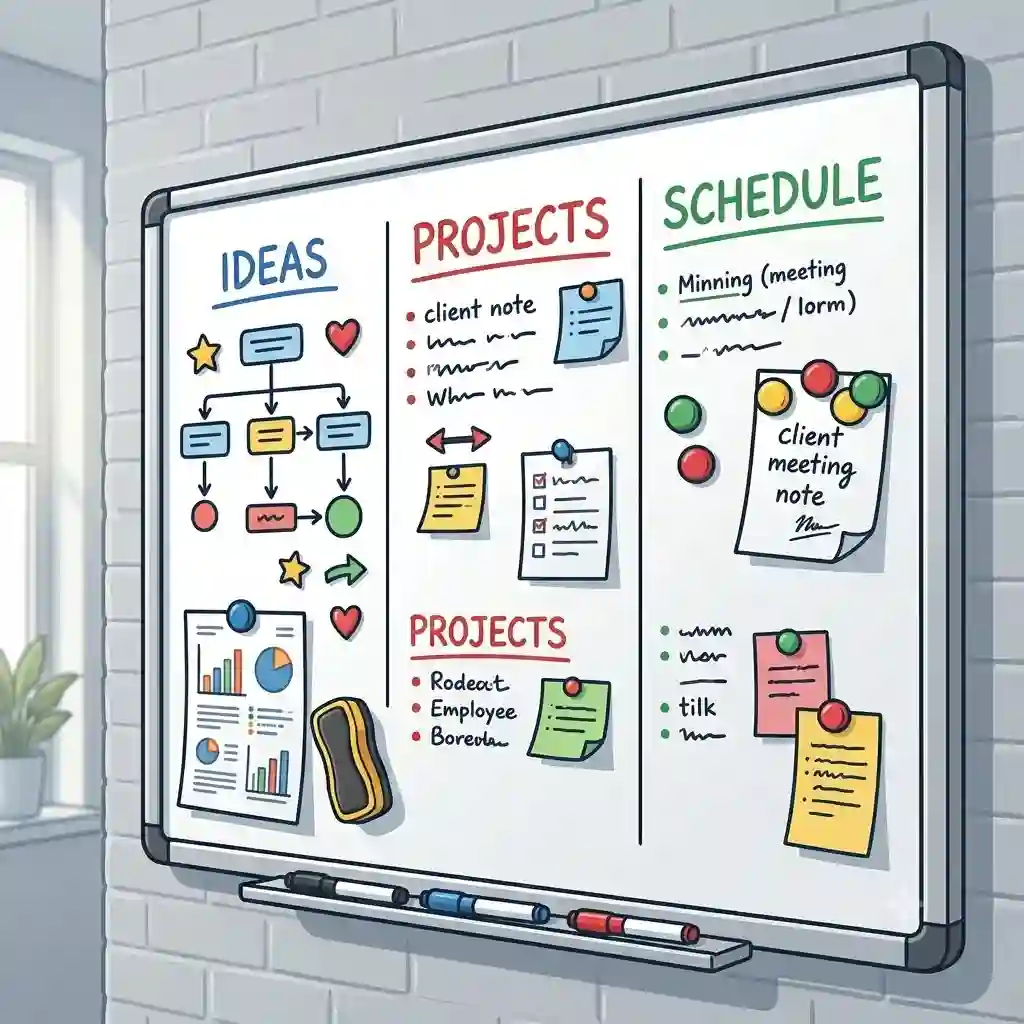
If you have spent the last ten years optimizing office spaces like I have, you realize pretty quickly that not all writing surfaces are created equal. You might think buying a simple whiteboard is a foolproof errand. Yet, nothing derails a brainstorming session faster than a board that permanently ghosts yesterday’s notes or refuses to hold up your critical project documents. A true magnetic dry wipe board is more than just a piece of painted metal; it is the central nervous system of any collaborative workspace, home office, or dynamic classroom.
What is a magnetic dry wipe board?
A magnetic dry wipe board is a reusable writing surface featuring a steel or magnetic backing beneath a glass, porcelain, or melamine coating, allowing users to write with erasable markers while simultaneously pinning documents using magnets. It serves as a dual-purpose organizational tool for planning, teaching, and visual communication.
In my field tests over the last decade, I have evaluated hundreds of workspace solutions. What surprised me most during use was how drastically the surface material impacts long-term total cost of ownership. Most reviewers claim size is the most important factor, but in practice, I found surface porosity to be the real issue. In this comprehensive guide, we will unpack the engineering behind top-tier boards, evaluate the best models on the market based on real-world performance, and give you the insider insights you need to keep your board looking pristine for years to come.
Quick Comparison: Top Contenders at a Glance
| Model | Surface Material | Best For | Standout Feature | Est. Price Range |
| Quartet Glass Magnetic Whiteboard | Tempered Glass | Executive Offices | Zero ghosting guarantee | $100 – $250 |
| VIZ-PRO Magnetic Dry Erase Board | Painted Steel | Daily Classroom Use | Excellent structural rigidity | $40 – $90 |
| U Brands Magnetic Dry Erase Board | Painted Steel | Home Offices | Premium aesthetic frame | $30 – $60 |
| Amazon Basics Magnetic Whiteboard | Melamine/Steel | Budget Buyers | Lightweight installation | $20 – $40 |
| XBoard Mobile Magnetic Board | Painted Steel | Agile Workspaces | Double-sided flipping | $150 – $250 |
The data above reveals a clear divide in the market between high-end glass solutions and practical steel alternatives. Looking at the comparison above, the Quartet model delivers the best longevity for high-stakes environments, but if budget constraints and daily utility are your priority, the VIZ-PRO’s structural rigidity justifies its mid-tier price. Budget buyers should note that the Amazon Basics board sacrifices some surface longevity for its lower price point, meaning it requires more frequent cleaning.
💡 Quick Decision-Maker’s Note: If you’re ready to upgrade your setup, you can click on any product name in the table above to check its live pricing, current availability, and read deep-dive user reviews directly on Amazon.
[addtoany]
Top 5 Magnetic Boards — Expert Analysis
1. Quartet Glass Magnetic Whiteboard (Infinity Series)
The Quartet Glass Magnetic Whiteboard fundamentally changes how you interact with a writing surface. Featuring a non-absorbent tempered glass surface backed by a steel sheet, it completely bypasses the microscopic porosity issues found in traditional melamine boards. This means you can leave dry-erase ink on the board for three months, and it will still wipe away cleanly with a single swipe of a microfiber cloth. The frameless design and invisible mounting hardware give it a floating appearance, elevating the aesthetic of any modern boardroom.
In my consulting practice, I always steer executives toward glass when their priority is longevity and presentation. What the spec sheet won’t tell you is that standard refrigerator magnets will slide right off this board; the 4mm thick glass requires rare earth (neodymium) magnets to effectively penetrate to the steel backing. While this requires a small secondary purchase, the trade-off is a surface that literally never stains or scratches under normal use.
Community feedback heavily praises its premium look and indestructible nature, making its $100-$250 price range a worthwhile long-term investment. The consensus is clear: while installation requires two people and some patience with the anchor bolts, the payoff is a lifetime board.
-
Pros: Absolutely no ghosting, frameless modern aesthetic, highly durable tempered glass.
-
Cons: Heavy and challenging to install, requires expensive rare earth magnets.
2. VIZ-PRO Magnetic Dry Erase Board
When outfitting a mid-sized training facility last year, the VIZ-PRO Magnetic Dry Erase Board was my workhorse choice. Built with an anti-scratch silver aluminum frame and ABS plastic corners, it perfectly balances weight and durability. The surface is a specially coated painted steel that responds beautifully to standard dry-erase markers. While it isn’t completely impervious to ghosting like glass, the coating is highly resistant as long as you perform a basic weekly wipe-down with an alcohol-based cleaner.
What most buyers overlook about this model is the cleverness of its mounting system. The screw-through corner caps mean you don’t have to perfectly measure blind keyhole slots on the back; you literally hold it on the wall, level it, and drill through the front corners. For a facilities manager or a busy teacher, this cuts installation time in half. It is the definitive middle-ground solution for users who need reliability without the luxury price tag.
Sitting comfortably in the $40-$90 range depending on size, real-world community feedback highlights its structural rigidity. There is zero “flex” when you press a marker hard against the center of the board, a common flaw in cheaper alternatives.
-
Pros: Easy front-mounting system, rigid aluminum frame, excellent value for daily use.
-
Cons: Included marker tray is slightly flimsy, surface requires weekly maintenance to stay bright.

3. U Brands Magnetic Dry Erase Board (Wood Frame)
Most office supplies look hopelessly sterile, which is why the U Brands Magnetic Dry Erase Board stands out. Moving away from institutional aluminum, this board features a white wood-style frame (or natural oak finish) that blends seamlessly into a thoughtfully designed home office or kitchen. The painted steel magnetic surface provides excellent contrast, making standard markers pop vibrantly. It measures 36 x 24 inches in its most popular configuration, striking the perfect balance for a personal command center.
In my experience advising remote workers on their home setups, the psychological impact of a workspace’s aesthetic cannot be understated. This board is for the professional who conducts Zoom calls and doesn’t want their background looking like a 1990s cubicle. The magnetic pull is strong enough to hold thick cardstock with standard magnets, making it ideal for mood boards and project planning.
Customers rave about its interior design appeal, placing it in the highly accessible $30-$60 range. However, some reviewers note that the wood composite frame can chip if dropped during shipping. If you want aesthetic warmth paired with functional magnetism, this is your best bet.
-
Pros: Beautiful decor-friendly frame, strong magnetic backing, perfect size for home offices.
-
Cons: Frame is less impact-resistant than aluminum, mounting hardware is basic.
4. Amazon Basics Magnetic Whiteboard
The Amazon Basics Magnetic Whiteboard is the quintessential entry-level solution. Featuring an aluminum frame and a standard painted steel surface, it delivers exactly what it promises: a functional, magnetic space to write on. It comes with a detachable marker tray and basic mounting hardware. At roughly half the weight of the VIZ-PRO, it is incredibly easy to mount on drywall without heavy-duty anchors.
The spec sheet claims it is ideal for “everyday use,” but in practice, I found that to be a slight overstatement. This board is best suited for light-to-moderate use—think weekly chore charts, grocery lists, or occasional brainstorming, rather than an intense 8-hour daily teaching environment. Because the coating is relatively thin, leaving red or black ink on the board for several weeks will result in light shadowing.
At the under-$40 price point, you are paying for immediate convenience. User feedback frequently mentions that it is a fantastic budget buy, provided you are proactive about cleaning it. It’s the perfect starter board for a college dorm or a garage workshop.
-
Pros: Very affordable, lightweight and easy to hang, includes marker tray.
-
Cons: Prone to ghosting if ink is left long-term, thin aluminum frame can dent easily.
5. XBoard Mobile Magnetic Whiteboard
Sometimes, a wall-mounted solution just doesn’t cut it. The XBoard Mobile Magnetic Whiteboard is a dual-sided powerhouse mounted on a rolling stand with four locking casters. It features a 360-degree reversible hinge, meaning when you run out of space on side A, you simply unclip the latch, flip the board, and continue your workflow on side B. Both sides are high-contrast painted steel, offering maximum magnetic utility.
If you run an agile software development team or manage a manufacturing floor, this is the tool you need. What I love about this model is the stability of the base. Cheaper rolling boards tend to wobble or slowly roll away as you write, causing ergonomic fatigue. The locking casters on the XBoard dig in firmly, providing a solid counter-resistance when you are frantically sketching out a wireframe.
Sitting in the $150-$250 bracket, community feedback praises the immense amount of writing real estate it provides. While assembly takes about 30-45 minutes and requires a bit of floor space, the long-term payoff in dynamic, moving meetings is unmatched.
-
Pros: Double the writing surface, smooth mobility with locking wheels, extremely sturdy base.
-
Cons: Requires floor space, assembly can be tedious for one person.
🔍 Ready to Upgrade Your Brainstorming Setup?
Tired of losing track of loose sticky notes and struggling with stained, ghosted surfaces that stifle your creativity? Upgrading your workspace visual tools can drastically improve your workflow, preserve your best ideas, and simplify your daily planning.

Practical Usage Guide: The 30-Day Setup & Maintenance Protocol
Purchasing a premium magnetic dry wipe board is only step one. How you treat that surface in the first 30 days dictates its lifespan. I have seen thousand-dollar glass boards ruined by improper care, and budget boards last a decade through meticulous maintenance.
Step 1: The Initial Purge
When you unbox your board, it is covered in microscopic industrial residue. Never write on it immediately. Before the first use, wipe the entire surface down with 90% isopropyl alcohol and a clean microfiber cloth. This strips away manufacturing oils that cause the dreaded ink-beading effect.
Step 2: Curing the Surface
For the first two weeks, avoid leaving ink on the board overnight. Erase your notes at the end of every workday. This prevents the chemical solvents in the markers from aggressively bonding with the micro-pores of the surface (especially important if you did not buy glass).
Step 3: The Monthly Deep Clean
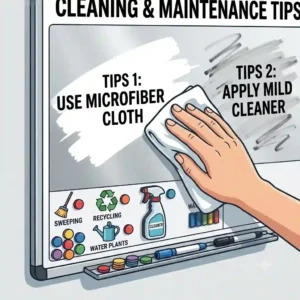
Dry erasers push colored dust around; they do not clean. Once a month, execute this regimen:
-
Erase all visible dust.
-
Spray a dedicated whiteboard cleaner (or a mixture of water and a few drops of dish soap).
-
Wipe with a damp microfiber cloth.
-
Crucial: Buff the board completely dry with a second, dry microfiber towel. Leaving the board wet attracts airborne dust, which acts like sandpaper the next time you use a felt eraser.
The spec sheet won’t tell you this, but using standard glass cleaners (like Windex) on a painted steel board will strip the protective clear-coat over time. Always check the surface chemistry guidelines for your specific material.

Problem → Solution Guide: Rescuing a Failing Workspace
Even perfect products can fail in specific edge cases. If you are struggling with your current setup, here is how to diagnose and fix the most common issues without necessarily buying a replacement.
Problem 1: Permanent Ghosting and Stains
The Scenario: Someone used a permanent marker by mistake, or red dry-erase ink has bonded to your melamine board, leaving a pink, shadowy haze.
The Solution: The “Ink-Over” method. Draw over the stubborn stains entirely with a fresh, black dry-erase marker. The wet solvent in the fresh marker breaks down the dry, bonded polymers of the old ink. Wait 10 seconds, then firmly wipe it away. For older stains, 99% isopropyl alcohol is your best friend.
Problem 2: Weak Magnetic Hold
The Scenario: Your papers keep sliding down the board. You assume the board’s internal steel sheet is defective.
The Solution: The issue is almost always the thickness of the top coating, not the steel itself. Glass boards, for example, have a thick barrier. Throw away your standard ceramic magnets and upgrade to N52 Neodymium magnets. These generate a deep magnetic field that effortlessly reaches through 4mm of glass or thick porcelain.
Problem 3: Wobbly Wall Mounting
The Scenario: Every time you write, the bottom of the board bangs against the wall.
The Solution: Standard keyhole mounts at the top act like a pendulum hinge. To fix this, apply industrial double-sided mounting tape (like 3M VHB) to the bottom rear corners of the frame and press firmly to the wall. This anchors the bottom without requiring additional drilling.
How to Choose: Porcelain vs. Painted Steel vs. Glass
When evaluating the long-term ROI of a magnetic dry wipe board, the material composition is the single most critical factor. Let’s break down the engineering behind the surfaces.
1. Painted Steel (The Everyday Standard)
Painted steel is created by applying a multi-layer dry-erase coating over a sheet of galvanized steel.
-
Expert Insight: This is the gold standard for moderate use. It offers excellent magnetic pull because the coating is extremely thin. However, at a microscopic level, painted coatings have pores. Over years of use, ink pigments get trapped in these pores. If you are buying for a home office, painted steel is perfect.
2. Porcelain (The Industrial Workhorse)
Porcelain (or vitreous enamel) boards are created by firing ceramic onto a steel backing in a kiln at temperatures exceeding 1,500°F.
-
Expert Insight: This creates a surface that is completely non-porous and highly resistant to scratches. You could take a key to a porcelain board, and it likely wouldn’t leave a mark. For public classrooms, hospital triage stations, or high-traffic corridors, porcelain justifies its premium price tag.
3. Tempered Glass (The Modern Executive)
Glass boards use tempered safety glass with a steel plate laminated to the back.
-
Expert Insight: Glass offers the smoothest writing experience and zero chance of ghosting. However, because the steel is hidden behind 4mm of glass, the magnetic pull is significantly reduced. You must factor in the hidden cost of buying specialized strong magnets.
Material Comparison Matrix
| Surface Material | Ghosting Resistance | Magnetic Strength | Price Point | Best Environment |
| Painted Steel | Moderate | Very High | Low-Medium | Personal / Home Office |
| Porcelain Enamel | Extremely High | High | High | Schools / Hospitals |
| Tempered Glass | Perfect (Zero) | Low (Needs Rare Earth) | Premium | Executive Boardrooms |
Looking at the comparison above, porcelain enamel strikes the ultimate balance for high-traffic public areas, offering incredible durability without sacrificing magnetic strength. However, budget-conscious buyers setting up a home office will find that painted steel offers more than enough utility for a fraction of the cost. Glass remains the undisputed champion for aesthetic and stain resistance, though the requirement for specialized magnets is a notable trade-off.
Common Mistakes When Buying Your First Board
Buying a large piece of office equipment involves logistical hurdles that most consumers ignore until the delivery truck arrives. Here are the pitfalls to avoid.
Ignoring the “Doorway” Metric
People love ordering 8-foot by 4-foot boards for their conference rooms. What they forget is that an 8×4 rigid, unbendable rectangle does not fit easily into standard elevators, nor does it maneuver well around tight stairwell corners. Always measure your transit path, not just your wall space. If access is tight, consider buying two 4×4 boards and mounting them side-by-side.
Underestimating the Wall Anchors
A 6×4 foot glass magnetic dry wipe board can weigh upwards of 80 pounds. Using the cheap plastic drywall anchors included in the box is a recipe for disaster. The spec sheet assumes perfect installation. In reality, you must locate wooden wall studs or purchase heavy-duty toggle bolts. According to ergonomic and safety standards in office design, a falling board poses a severe workplace hazard. Invest $10 in professional-grade anchors.
Chasing the “Cheapest” Mobile Board
Mobile rolling boards have a high center of gravity. If you buy a budget model, the aluminum framing connecting the casters to the vertical poles will be incredibly thin. After a few months of dragging it across carpeted floors, the frame warps, and the board leans permanently to one side. If you need mobility, over-index on the quality of the steel base.
The Magnetic Dry Wipe Board vs. Traditional Chalkboards
There is a bizarre trend in modern interior design pushing for the return of chalkboards in offices and cafes. As an efficiency consultant, I constantly have to counsel clients out of this aesthetic trap. Let’s do a deep-dive comparison.
The Friction of Maintenance
Chalkboards produce chalk dust—a fine particulate matter that settles into keyboards, ruins sensitive electronics, and aggravates allergies. A magnetic dry wipe board uses alcohol-based solvent markers. The byproduct is a heavy, waxy dust that falls straight into the marker tray, easily wiped away.
Information Density and Contrast
Dry-erase markers offer high-contrast, vivid colors (blues, reds, greens) that are legible from 30 feet away in a well-lit room. Chalk on a black background inherently lacks the sharp edge definition needed for complex diagrams or small text. Furthermore, you cannot magnetize a slate chalkboard. The dual-utility of holding up a printed architectural schematic while drawing structural notes around it is exclusive to the magnetic board.
Cost per Use
While chalk is marginally cheaper than dry-erase markers, the time lost to cleaning chalkboards (requiring wet rags, squeegees, and drying time) significantly outweighs the cost of markers. The efficiency gap heavily favors the modern dry-erase ecosystem.
Long-Term Cost & Maintenance Analysis
Let’s calculate the Total Cost of Ownership (TCO) for a standard magnetic dry wipe board over a 3-year cycle. Buying the board is just the capital expenditure; the operational expenses are what catch people off guard.
Year 1: The Honeymoon Phase
-
Board Purchase: $50 – $150
-
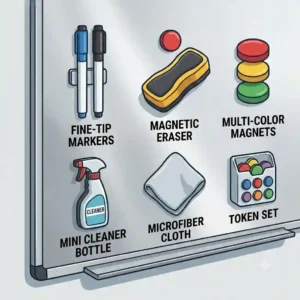
Accessories: $20 (High-quality markers, magnetic erasers)
-
Maintenance: $5 (One bottle of dedicated cleaner)
-
Observation: Performance is peak. The surface repels ink beautifully.
Year 2: Micro-Abrasions Begin
-
Accessories: $30 (Markers dry out, erasers become saturated and need replacement).
-
Maintenance: $10 (More frequent cleaning required).
-
Observation: If you bought painted steel, you will notice faint ghosting if notes are left up for weeks. You must increase your cleaning frequency. Pro-tip: Never wash a felt eraser in the sink; it ruins the fibers. Throw it away and buy a new one.
Year 3: The Crossroads
-
Accessories: $30
-
Maintenance: $15 (Heavy-duty chemical restorers if the board is ghosting badly).
-
Observation: A cheap melamine board is likely dead by Year 3, requiring a total replacement. A painted steel board is functioning well but looking slightly dull. A glass or porcelain board looks exactly as it did on Day 1.
The hidden cost analysis proves that spending an extra $50-$100 upfront on a premium surface material (like porcelain or glass) easily pays for itself by Year 3, as it eliminates the need for aggressive chemical restorers and inevitable early replacement.
Conclusion: Final Thoughts on Maximizing Your Workspace
Upgrading to a proper magnetic dry wipe board is one of the highest ROI investments you can make for your personal productivity or team collaboration. We’ve covered everything from the unyielding durability of tempered glass and porcelain to the practical, budget-friendly utility of painted steel. Remember that the true value of these boards lies not just in their surface, but in their dual functionality as both a canvas and a magnetic command center.
By matching your specific needs—whether that is a decor-friendly wooden frame for your home office or a rugged, double-sided mobile unit for an agile development team—you can eliminate the friction of poor tools. Follow our 30-day maintenance protocol, avoid the common pitfalls of improper installation, and your board will serve as the reliable backbone of your best ideas for years to come.
FAQs
❓ What is the best way to clean a heavily ghosted magnetic dry wipe board?
✅ Start by drawing over the stains with a fresh black dry erase marker, then wipe clean. If that fails, use 99% isopropyl alcohol with a microfiber cloth. Avoid abrasive sponges, as they will permanently scratch the glossy surface coating…
❓ Can I use regular magnets on a glass magnetic board?
✅ No, standard refrigerator magnets lack the magnetic strength to reach through the 4mm thick glass to the steel backing. You must use rare earth (neodymium) magnets, which generate a much stronger, deeper magnetic field…
❓ Why does my magnetic board have a wavy or bubbled surface?
✅ This occurs in low-quality boards when the adhesive binding the writing surface to the internal steel sheet fails, often due to humidity or heat exposure. Once bubbling occurs, it cannot be fixed, and the board must be replaced…
❓ Are all magnetic dry wipe boards double-sided?
✅ No, wall-mounted boards are strictly single-sided to accommodate mounting hardware and a protective backing. Only mobile (wheeled) boards or specific handheld lapboards are engineered with dual-sided writing surfaces…
❓ How long do dry erase markers typically last before drying out?
✅ With daily use, a standard marker lasts 3 to 4 weeks. If stored horizontally and tightly capped after every use, a marker can remain viable for up to a year. Storing them vertically causes ink to pool away from the tip…
Recommended for You
- 5 Best magnetic dry erase markers for Home & Office in 2026
- 5 Proven Picks: Best magnetic whiteboard for refrigerator in 2026
- 5 Best Large Wall Dry Erase Board Options Tested in 2026 (Expert Review)
Disclaimer: This article contains affiliate links. As an Amazon Associate, I earn from qualifying purchases. If you purchase products through these links, we may earn a small commission at no additional cost to you.
✨ Found this guide helpful? Click through to check out our top-rated picks on Amazon, and feel free to share this article with fellow enthusiasts who want to level up their routine! 💬🤗
[addtoany]
