
Let’s be real. The “Sunday Scaries” hit differently in college. It’s not just about work tomorrow; it’s about that 10-page paper, three midterms, a group project, your work-study shift, and somehow finding time to eat something other than instant ramen. Syllabus week drops a mountain of dates on you, and your phone’s calendar? It just feels… cluttered.
✨Was this helpful? Spread the word! 🚀
[addtoany]
This is where finding one of the best planners for college students becomes less of a suggestion and more of a survival tactic. A good academic planner is the difference between “I got this” and “I’m living on caffeine and pure panic.”
But why go analog in a digital world? Your phone is great, but it’s also a highway of distractions. A paper planner is a dedicated, quiet space. It forces you to unplug, focus, and physically process your schedule. Because of this, you’re more likely to remember what you write down.
However, not all planners are created equal. Choosing the wrong one is like picking the wrong major—you’ll be miserable by October. Let’s compare the core philosophies before we dive in.
Analog vs. Digital: The Campus Showdown
| Feature | 📝 Analog Paper Planner | 📱 Digital Calendar App |
| Focus | ✅ High (No notifications) | ❌ Low (Distractions abound) |
| Memory | ✅ Excellent (Writing aids retention) | ⚠️ Okay (Typing is less effective) |
| Customization | ✅ High (Stickers, color-coding) | ⚠️ Medium (Limited by app) |
| Portability | ⚠️ Medium (Can be bulky) | ✅ Excellent (Always on you) |
| Sharing | ❌ Difficult (Need to take a pic) | ✅ Easy (Shared invites) |
| Battery Life | ✅ Infinite (It’s paper) | ❌ Poor (Dead phone = lost schedule) |
As you can see, for the deep work and focus required in college, analog often wins. So, let’s find the best planner for college student needs, starting with a quick overview of our top picks.
📊 Quick Comparison: Top 7 Best Planners for College Students
| Product | Best For | Layout | Key Feature |
| Blue Sky Academic Year Planner | All-Around Function | Weekly & Monthly | Classic, no-frills organization |
| Passion Planner (Academic) | Goal-Setters & Creatives | Weekly (Hourly) & Monthly | Passion RoadMap goal system |
| Moleskine Classic 12-Month | Minimalists & Writers | Weekly (Notes) & Monthly | Iconic design, high-quality paper |
| Amazon Basics Academic Planner | The Budget-Conscious | Weekly & Monthly | Simple, effective, and affordable |
| Erin Condren Academic Planner | Customization Queens/Kings | Weekly (Vertical) & Monthly | Premium paper, spiral, tons of extras |
| Panda Planner Pro | Productivity & Mindfulness | Daily, Weekly, Monthly (Undated) | Scientific approach to happiness |
| Lemome Academic Planner | Pen Aficionados | Weekly & Monthly | Ultra-thick 128gsm paper |
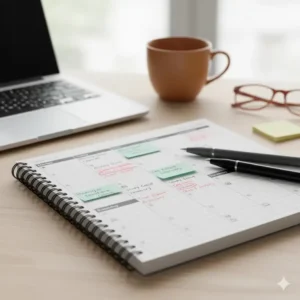
⭐ Top 7 Best Planners for College Students: Expert Analysis
Finding the right planner for college is deeply personal. Do you need to see your day by the hour, or just a 30,000-foot view? Do you want space for notes, or do you live by a to-do list?
I’ve analyzed dozens of options to find the top 7 academic planners for college students that actually work for a hectic campus life.
1. Blue Sky 2025-2026 Academic Year Weekly & Monthly Planner
Best For: The student who needs a classic, reliable, and affordable workhorse.
This is the quintessential student planner. Blue Sky planners are a campus bookstore staple for a reason. They are practical, professional, and don’t overwhelm you with “fluff” you’ll never use.
- Detailed Specifications:
- Layout: 2-page monthly spreads (tabbed) + 2-page weekly spreads (lined).
- Dates: July 2025 – June 2026 (12 Months).
- Size: Available in multiple, but 8.5″ x 11″ is common for desks, 5″ x 8″ for backpacks.
- Binding: Twin-wire binding (lies flat).
- Extras: Dedicated notes pages, reference calendars, list of holidays, contacts page.
- Cover: Flexible but durable poly cover (survives spills).
- Customer Review Analysis: Users consistently praise the Blue Sky planner for its “simple, clean layout” and “sturdy construction.” Many students note it’s the “perfect amount of space” for daily assignments without feeling overwhelming. The primary critique is that the paper, while good, isn’t the thickest, so “inky gel pens or sharpies might ghost.”
- Warranty: Typically covered by Amazon’s standard 30-day return policy. Blue Sky also has a customer service guarantee for manufacturing defects.
- Pros:
✅Incredibly affordable and accessible.✅Clean, professional design.✅Durable cover and strong spiral binding.
✅Tabbed months for easy navigation.
- Cons:
❌Paper is standard-grade; not ideal for heavy inks.❌Lacks “extra” features like goal-setting or habit tracking.
2. Passion Planner (Academic Year)
Best For: The goal-oriented student who wants to manage their time and their dreams.
The Passion Planner is more than a scheduler; it’s a life management system. It was created to help people break down their long-term goals into actionable steps. For a college student, this is a game-changer for balancing a 5-year plan with a 5-page paper due tomorrow.
- Detailed Specifications:
- Layout: Weekly layouts broken down by the hour (6 AM – 10:30 PM). Monthly layouts with a “monthly focus” section.
- Dates: Academic (Aug – Jul) or Undated versions available.
- Size: Medium (A5) or Large (A4-ish).
- Binding: Softcover (faux leather) or Hardcover.
- Extras: “Passion RoadMap” goal-setting guide, weekly/monthly check-ins, “Space of Infinite Possibility” (blank/grid for notes/dreams), good/bad habit trackers.
- Paper: Thick 120gsm, sustainable, bleed-resistant paper.
- Customer Review Analysis: The reviews (from the “PashFam” community) are glowing. Students love that it “keeps my crazy pre-med schedule straight” and “helps me connect my daily tasks to my long-term goals.” The main “con” is that it “requires a learning curve” and “you have to commit to using it.” Some also find the hourly layout too rigid.
- Warranty: Passion Planner offers a 100% money-back guarantee if you don’t love it, plus a “Get One, Give One” program.
- Pros:
✅Holistic system for goals, not just tasks.✅Hourly layout is perfect for time-blocking classes.✅High-quality, eco-friendly, thick paper.
✅Durable and professional-looking softcover.
- Cons:
❌Can be bulky and heavy.❌The system can be overwhelming for casual users.❌More expensive than basic planners.
3. Moleskine Classic 12-Month Weekly Planner
Best For: The minimalist, the writer, the student who wants a planner that looks and feels professional.
Walking into a lecture and pulling out a Moleskine makes a statement. It’s timeless, elegant, and built for people who value simplicity. It’s one of the best student planners college-bound individuals can get if they value note-taking as much as scheduling.
- Detailed Specifications:
- Layout: Weekly Notebook layout. The week’s appointments are on the left page, and a ruled page for notes, to-do lists, and thoughts is on the right.
- Dates: 12-month (Jan-Dec) or 18-month (Jul-Dec) options.
- Size: Large (5″ x 8.25″) is the most popular and portable.
- Binding: Hardcover or softcover with thread-binding (lies flat).
- Extras: Elastic closure, ribbon bookmark, expandable inner pocket (perfect for syllabi printouts), history of Moleskine.
- Paper: Classic 70gsm, acid-free, ivory-colored paper.
- Customer Review Analysis: Users buy this for the “vibe” and the “paper quality.” It’s “perfect for my humanities classes where I have a lot of reading notes.” The “week-on-one-side” layout is beloved. The major complaint? “The 70gsm paper is not fountain pen friendly.” It’s thin, so ghosting is a real issue with anything but a standard ballpoint.
- Warranty: Moleskine stands by its quality and will replace planners with manufacturing defects (like binding issues).
- Pros:
✅Incredibly portable and durable.✅Iconic, professional, minimalist design.✅The “Notes” page opposite the weekly view is fantastic.
✅Inner pocket is surprisingly useful.
- Cons:
❌Thin paper can ghost or bleed.❌No academic-year-specific (Jul-Jun) versions in this classic format.❌Lacks tabs or any monthly/weekly dividers.
4. Amazon Basics Academic Year Weekly/Monthly Planner
Best For: The student on a tight budget who just needs to get the job done.
Sometimes, you don’t need a life coach in a binder. You just need to know when your Psych midterm is. This Amazon Basics Academic Planner is the definition of “no-frills.” It’s a surprisingly solid choice and one of the best planners for college when cost is a major factor.
- Detailed Specifications:
- Layout: 2-page monthly spreads + 2-page weekly spreads (lined).
- Dates: 12-Month Academic Year (July – June).
- Size: 8.5″ x 11″ (desk size).
- Binding: Twin-wire binding.
- Extras: Tabbed months, 3-year reference calendar, holiday list, clear front cover “pocket” for customization (like your class schedule).
- Cover: Flexible plastic front cover, sturdy cardboard back.
- Customer Review Analysis: Reviews are overwhelmingly positive for the price. It’s praised as “a fraction of the cost of name brands” and “does the exact same thing.” Students love the clear front pocket. The negatives are predictable: “the cover can crack by spring semester” and “the paper is thin.”
- Warranty: Covered by Amazon’s standard return policy.
- Pros:
✅Extremely inexpensive.✅Clear front pocket is a genius addition for a syllabus or class schedule.✅Simple, functional, and easy-to-use layout.
- Cons:
❌Not built to last for years; a one-semester wonder.❌Area_A:❌Thin paper.
❌Very basic (almost boring) design.

5. Erin Condren Academic Planner (Coiled)
Best For: The student who loves customization, stickers, and a “luxe” planning experience.
If your planner is also your hobby, this is for you. The Erin Condren Academic Planner is the high-end, fully customizable option. It’s less a tool and more a companion, designed to make planning fun.
- Detailed Specifications:
- Layout: Unique vertical weekly layout with 7 sections (one for each class, or subject). Also includes monthly spreads, project/exam trackers.
- Dates: 12-Month (can choose start/end).
- Size: 7″ x 9″ (their signature size).
- Binding: Heavy-duty aluminum coil (platinum, gold, or rose gold).
- Extras: Interchangeable, customizable covers. 4 sheets of coordinating stickers. “Snap-in” rulers/dashboards (sold separately). Vellum overlay. Laminated tabs.
- Paper: Thick, rich 80 lb. (118gsm) Mohawk paper.
- Customer Review Analysis: People are obsessed with the “buttery smooth” paper that “takes any pen you throw at it.” The vertical layout divided into sections is a “game-changer for tracking different classes.” The primary, and significant, con is the price. It’s “an investment” and “the coil is bulky” in a backpack.
- Warranty: Erin Condren has a happiness guarantee and will work to fix any quality issues.
- Pros:
✅Unmatched paper quality.✅Extremely customizable (covers, layouts, accessories).✅Built-in sections for classes, projects, and exams.
✅Visually stunning and fun to use.
- Cons:
❌Very expensive.❌The coil binding is thick and can be cumbersome.❌Can become heavy with accessories.
6. Panda Planner Pro
Best For: The student struggling with overwhelm, anxiety, or productivity.
The Panda Planner Pro isn’t an academic planner by default (it’s undated), but its system is perfect for the college mindset. It’s based on positive psychology and productivity principles to help you manage your tasks and your mental health.
- Detailed Specifications:
- Layout: A unique system of three separate sections: Daily (2 pages per day), Weekly, and Monthly.
- Dates: Undated (lasts 3-6 months, this is the “Pro” version).
- Size: 8.5″ x 11″ (Pro size).
- Binding: Hardcover, thread-bound.
- Extras: Daily pages include “Morning Review” (Gratitude, Focus, Exercise) and “End of Day Review” (Wins, How I’ll Improve). Comes with free e-books on productivity.
- Paper: High-quality, thick, bleed-resistant paper.
- Customer Review Analysis: This planner has a cult following. Students say it “helped me get out of a rut” and “forces me to be mindful about my day.” The daily review sections are a huge hit. The main complaints: “It’s undated, so setup takes time,” and “You have to flip between daily, weekly, and monthly sections,” which some find “clunky.”
- Warranty: 100% money-back guarantee. If you don’t find it improves your life, they’ll refund you.
- Pros:
✅Fantastic system for mindfulness, gratitude, and productivity.✅Breaks tasks down into manageable daily/weekly/monthly goals.✅Undated for maximum flexibility (can start anytime).
✅High-quality build and paper.
- Cons:
❌Only lasts 3-6 months, not a full academic year.❌Constant flipping between sections.❌Daily setup (writing in dates) can be tedious.
7. Lemome Academic Planner
Best For: The student who wants a Moleskine’s professionalism but with paper that can handle anything.
The Lemome Academic Planner is a lesser-known gem that beats many premium brands on one key feature: paper. It’s designed for people who are serious about their pens and want a planner that feels substantial.
- Detailed Specifications:
- Layout: Standard 2-page monthly + 2-page weekly (horizontal, lined) spreads.
- Dates: 12-Month Academic Year (July – June).
- Size: A5 (5.7″ x 8.4″).
- Binding: Durable hardcover (faux leather) with thread-binding (lies flat).
- Extras: Pen loop (a small but crucial detail!), elastic closure, 2 ribbon bookmarks, expandable inner pocket, 128gsm ultra-thick paper.
- Paper: 128gsm! Almost twice as thick as a Moleskine’s.
- Customer Review Analysis: The reviews are almost entirely about the paper: “No ghosting. No bleeding. At all.” “My fountain pen loves this paper.” Beyond that, users love the “thoughtful extras” like the pen loop and dual bookmarks. The main negative is that the “binding is very stiff” at first and needs to be broken in.
- Warranty: Standard manufacturer 1-year guarantee against defects.
- Pros:
✅Incredibly thick, smooth, 128gsm paper.✅Tons of professional features (pen loop, 2 bookmarks, pocket).✅Durable, elegant hardcover design.
✅Lies flat once broken in.
- Cons:
❌Binding can be stiff initially.❌Slightly heavier than other A5 planners due to paper thickness.❌Weekly layout is simple/horizontal (a con for some).
✨ Don’t Miss These Organizational Lifesavers!
🔍 Ready to finally conquer your schedule? These college student planners are reviewer-approved and student-tested. Click any highlighted item to check detailed specs, see current pricing, and read more reviews on Amazon!
💬 Just one click – help others make better buying decisions too!😊
[addtoany]
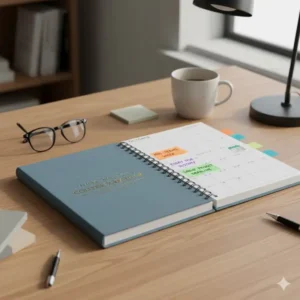
🤔 Why Bother? The Real Reasons a Paper Planner Still Rules Campus
In a world of Google Cal and Outlook, dedicating a section to “why paper” seems old-fashioned. But here’s the thing: your brain on paper is different from your brain on pixels.
For college students, the benefits aren’t just about organization; they’re about learning.
- The Encoding Hypothesis: This is a fancy term for a simple fact: writing helps you remember. A 2014 study published in Psychological Science found that students who took notes by hand (like in a planner) had a better conceptual understanding of the material than students who typed. The act of writing forces your brain to process and summarize information, “encoding” it more deeply. This applies to your schedule, too.
- A Distraction-Free Zone: Your phone is designed to steal your attention. Every time you open your calendar, you see a text, an Instagram notification, and a news alert. Your paper planner has one job. It’s a “deep work” tool in a “shallow work” world.
- The “Big Picture” View: Swiping between “day” and “month” on a tiny screen is terrible for seeing how your time actually flows. A paper planner lets you see your entire week or month at a glance. You can physically see the white space (or lack thereof) and make better decisions about whether you really have time to join that committee.
Cognitive Benefits: Handwriting vs. Typing
| Cognitive Function | ✍️ Handwriting (in a Planner) | ⌨️ Typing (in an App) |
| Memory Encoding | Deep Processing. Forces summarization and conceptualization. | Shallow Processing. Often leads to “mindless transcription.” |
| Focus | High. Single-tasking environment. | Low. High risk of notification-based distraction. |
| Spatial Recall | Strong. You remember “it was on the top left page.” | Weak. Information is in a formless, scrolling list. |
| Idea GenerationS: | High. The “notes” section encourages free-form thought. | Low. Constrained by the app’s UI and text fields. |
🔎 How to Choose Your Perfect Planner for College
Okay, you’re sold on paper. Now what? Picking from the list above is a start, but the best college planners are the ones that fit your brain. Here’s your decision-making framework.
1. Layout: The “Operating System” of Your Planner
This is the most critical choice. How do you see your time?
- Weekly (Horizontal): Best for list-makers. You get a lined space for each day. Great for tracking 3-5 key assignments/tasks per day. Not great for scheduling classes by time.
- Weekly (Vertical): Better for schedulers. You get a vertical column for each day, often broken down into morning/afternoon/evening. Good for seeing “blocks” of time.
- WarningArea:
- Weekly (Hourly): The boss level. (e.g., Passion Planner). Every day is broken into 30 or 60-minute slots. This is the ultimate tool for “time-blocking” and essential for students with packed, complex schedules (e.g., pre-med, athletes, multiple jobs).
- Daily: (e.g., Panda Planner Pro). A full page per day. This is for the extremely detailed person, but it can be very bulky and heavy to carry.
Planner Layouts: Pros vs. Cons
| Layout Style | 👍 Pros | 👎 Cons |
| Weekly (Horizontal) | Great for to-do lists; simple; lots of writing space per task. | Bad for time-based scheduling; can look cluttered. |
| Weekly (Vertical) | Good visual for “blocks” of time; clean, structured look. | Less space for long-form notes or to-do lists. |
| Weekly (Hourly) | Perfect for time-blocking; impossible to double-book. | Rigid; can be stressful to see “empty” time; setup-intensive. |
| Daily (Full Page) | Massive space for detail, notes, journaling, tasks. | Very bulky; hard to see the “week at a glance.” |
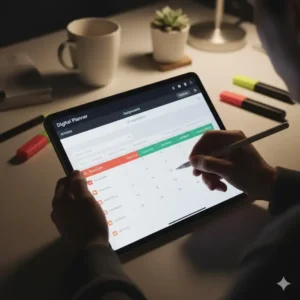
2. Size & Portability (The Backpack Test)
- Large (8.5″ x 11″): A “desk planner.” Great for your dorm room, offers tons of space. Awful to carry to class.
- Medium (7″ x 9″ or A5): The “sweet spot” for most college student planners. Fits in a backpack, but still has enough room to write.
- Small (A6 or Pocket): Ultra-portable, but you’ll be writing tiny. Better as a satellite to-do list, not a main academic planner.
3. Binding: What Holds It All Together
This might seem minor, but it affects usability every single day.
Binding Types: Which Survives a Backpack?
| Binding | How it Works | Pros | Cons |
| Spiral / Twin-Wire | Metal coil (e.g., Blue Sky, Erin Condren) | ✅ Lies perfectly flat or folds back 360°. | ❌ Coil can get bent/snagged; bulky. |
| Thread-bound | Stitched pages (e.g., Moleskine, Lemome) | ✅ Professional look; durable; lies flat once broken in. | ❌ Doesn’t lie flat out of the box; no 360° fold. |
| Discbound | Individual pages on plastic discs. | ✅ Infinitely customizable; add/remove pages. | ❌ Pages can tear out; discs are bulky. |
| 3-Ring Binder | Standard binder system. | ✅ Cheap; customizable. | ❌ Bulky, “clacky,” and pages tear easily. (Avoid). |
4. Paper Quality (The Pen Test)
If you’re a pen snob, listen up. Paper “weight” is measured in “gsm” (grams per square meter).
- < 70gsm (e.g., Moleskine): Thin. Ballpoint pens only.
- 80-100gsm (e.g., Blue Sky): Standard. Good for most gel pens (like a G2).
- 110gsm+ (e.g., Passion Planner, Lemome, Erin Condren): Thick & “luxe.” These can handle fountain pens, Sharpies, and highlighters with minimal ghosting or bleeding.
Features That Make the Best Student Planners College-Proof
When you’re comparing planners for college, look for these academic-specific lifesavers.
- Tabbed Months: Non-negotiable. You need to flip to May to add your final exam date fast.
- “Syllabus” or “Class Schedule” Pages: A dedicated spot at the front to list your classes, professors, office hours, and (most importantly) grading policy.
- Project & Exam Trackers: Grid-style pages that let you map out long-term assignments.
- Built-in Pocket: For holding loose papers, syllabi, or that random club flyer.
- Pen Loop: (e.g., Lemome). You will lose your favorite pen. A pen loop stops this.
“Must-Have” vs. “Nice-to-Have” Planner Features
| Feature Category | 🚨 Must-Have | ✨ Nice-to-Have |
| Navigation | Monthly Tabs, Weekly Layouts | Ribbon Bookmarks, Snap-in Ruler |
| Academic | Class Schedule Page, Notes Space | Dedicated Project/Exam Trackers |
| Construction | Durable Cover (Poly or Hardcover) | Pen Loop, Elastic Closure, Inner Pocket |
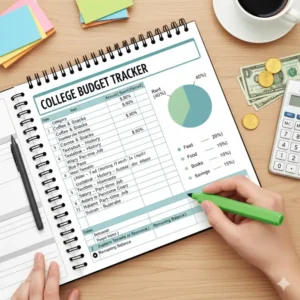
| Extras | Reference Calendar (2-3 years) | Stickers, Goal-Setting Pages, Budget Sheets |
✍️ The DIY Option: Is a Bullet Journal Better?
You might be thinking, “These are all great, but none are perfect.” If you’re creative and have a bit of time, the “Bullet Journal” (BuJo) method might be your answer.
A BuJo is a 100% DIY planner you create in a simple, dotted notebook. You can read a full guide at BulletJournal.com, but here’s the gist.
DIY Bullet Journal vs. Pre-Made Planner
| Factor | 📓 DIY Bullet Journal (BuJo) | 📒 Pre-Made Planner (e.g., Passion Planner) |
| Cost | ✅ Very low (Just a notebook & pen). | ⚠️ Can be expensive ($20 – $60+). |
| Customization | ✅ Infinite. 100% tailored to your needs. | ❌ Fixed. You’re stuck with the layout. |
| Time Setup | ❌ High. You must draw all your layouts. | ✅ Zero. It’s ready to go. |
| Intimidation | ⚠️ High. “Pinterest-perfection” anxiety. | ✅ Low. Just open and write. |
| Best For | The creative, self-motivated, and flexible student. | The busy, structured, “just-tell-me-where-to-write” student. |
💡 How to Actually Use Your Planner (and Not Ditch It by October)
Buying a planner and using a planner are two different things. That new-planner smell is great, but the real magic happens with routine.
- The “Sunday Setup” 📅: This is the most important 30 minutes of your week. Sit down with your syllabi, your email, and your planner.
- Look at the “week ahead.”
- Write down all “hard” deadlines: exams, papers, work shifts.
- Block out “hard” commitments: class times, labs, commute.
- Look at the “white space” and pencil in “study time” and “social time.”
- Color-Coding Your Life 🎨: Don’t just write… visualize. Get a pack of 4-color pens or highlighters.
- Blue: Academic Deadlines
- Green: Work/Money
- Pink: Social/Personal
- Orange: Exams/Urgent
- This lets you see in a glance where your time is really going.
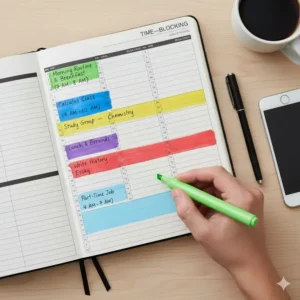
- Time-Blocking Your 8 AMs (and Your Fun) ⏰: Don’t just write “Study for Bio.” That’s not a task; it’s a nightmare.
- Instead, on your hourly planner, block out:
- 4:00 PM – 4:45 PM: Review Bio Ch. 4
- 4:45 PM – 5:00 PM: Break (scroll TikTok)
- 5:00 PM – 5:45 PM: Bio Ch. 4 practice problems
- This concept is often called time management, and many universities, like Dartmouth College, have resources to help students master it.
Sample Weekly Time-Blocking Schedule (Vertical Layout)
| Time | Monday | Tuesday | Wednesday | Thursday | Friday |
| 8 AM | ☕️ | 🔬 CHEM LAB | ☕️ | 🔬 CHEM LAB | 😴 |
| 9 AM | 🏛️ HIST 101 | 🔬 CHEM LAB | 🏛️ HIST 101 | 🔬 CHEM LAB | ☕️ |
| 10 AM | 🗣️ SPANISH | ☕️ Break | 🗣️ SPANISH | ☕️ Break | 🗣️ SPANISH |
| 11 AM | 💻 Work-Study | 📖 Study Block | 💻 Work-Study | 📖 Study Block | 💻 Work-Study |
| 12 PM | LUNCH | 🏃 Gym | LUNCH | 🏃 Gym | LUNCH (Friends) |
| 1 PM | 📖 Hist. Reading | 📖 Chem Study | 📖 Hist. Reading | 📖 Chem Study | 🧹 Chores |
| 2 PM | 📖 Hist. Reading | 📖 Chem Study | 📖 Hist. Reading | 📖 Chem Study | (Free) |
| 3 PM | (Free) | (Free) | (Free) | (Free) | (Free) |
🚀 Ready to Get Organized?
You’ve seen the specs, you know what to look for. Stop letting your deadlines sneak up on you! Take control of your semester by picking one of the amazing college planners from our list. Click your favorite to see more details and grab one on Amazon before the semester gets really crazy!
🏁 Conclusion
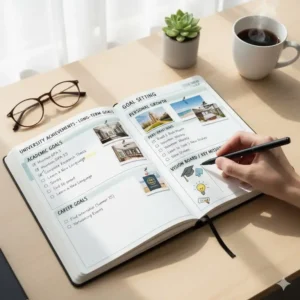
Let’s be honest: college is a masterclass in juggling. And while no piece of paper can write your essays for you, the best planners for college students are the next best thing. They are a physical, dedicated space to turn the chaos of your schedule into an actionable plan.
Whether you’re a minimalist who just needs a Moleskine and a pen, a goals-driven student who needs a Passion Planner, or a budget-conscious buyer happy with an Amazon Basics model, the act of planning is what matters.
Choosing one of the top planners for college we’ve reviewed here is your first step toward a less stressful, more organized, and ultimately more successful academic year. So, pick the one that feels right, grab your favorite pen, and go ace that 8 AM lecture. You’ve got this.
❓ Frequently Asked Questions
❓ What kind of planner is best for a college student?
❓ Is a daily or weekly planner better for college?
❓ What's the best size planner for college?
❓ Where can I buy the best college student planners?
❓ Is an undated or dated planner better for college students?
Recommended for You
- 4 Month Dry Erase Calendar: Ultimate 2025 Guide
- Quarterly Wall Calendar: 7 Top Picks for 2025 Planning
- 4 Month Dry Erase Calendar: Ultimate 2025 Guide
Disclaimer: This article contains affiliate links. If you purchase products through these links, we may earn a small commission at no additional cost to you.
✨ Found this helpful? Share it with your friends! 💬🤗
[addtoany]
