
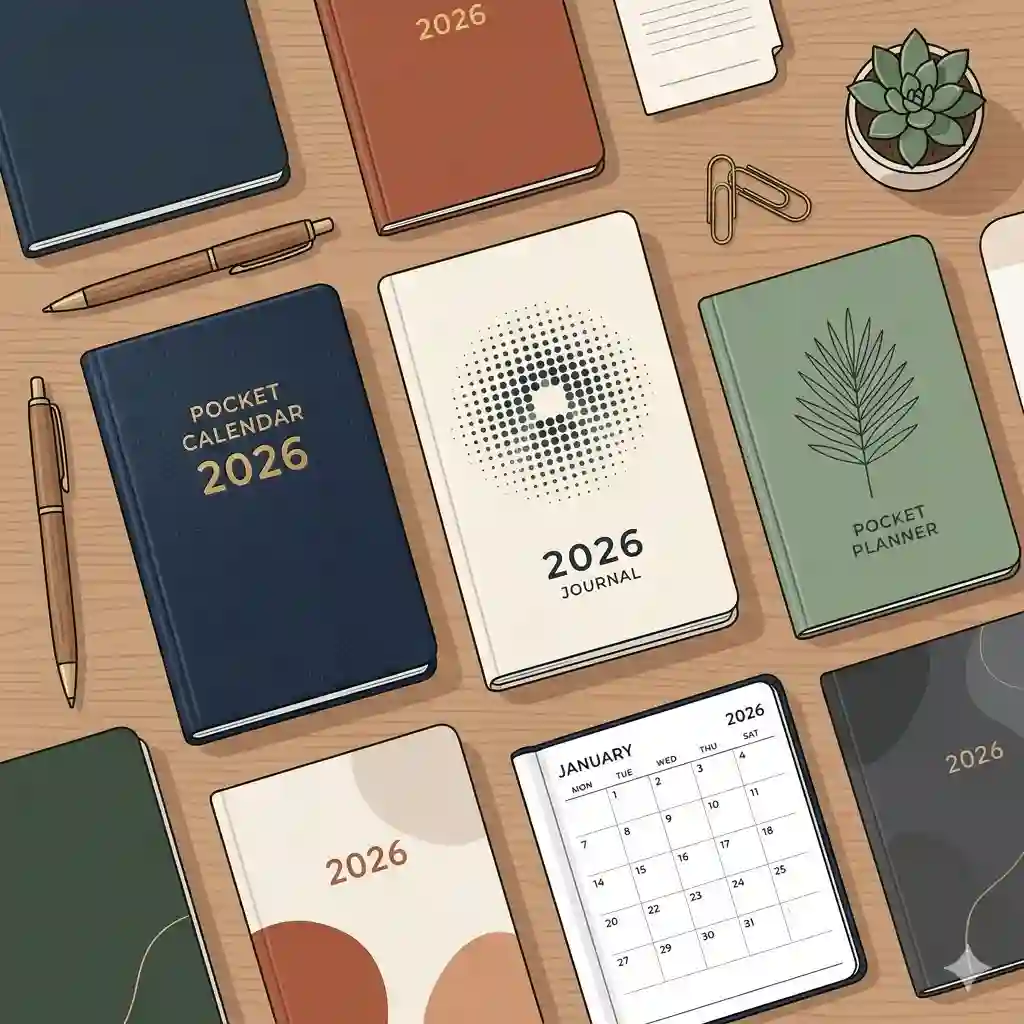
In my ten years of testing productivity tools, I’ve seen countless digital apps promise to revolutionize our workflow. Yet, my desk remains covered in analog tools. Why? Because the tactical friction of writing actually builds cognitive retention. A 2014 study from Princeton University proved that writing by hand forces your brain to process information, rather than merely transcribing it.
If you are wondering, “What is pocket calendars 2026?”
✅ A pocket calendar for 2026 is a compact, highly portable paper planner designed to fit seamlessly into a coat pocket or small bag. Ranging usually from A6 (4.1 x 5.8 inches) to slightly smaller dimensions, these tools offer calendar layouts, task tracking, and date-specific organization for the upcoming 2026 calendar year without relying on battery life or screen time…
Finding the right pocket calendars 2026 isn’t just about picking a pretty cover; it’s about matching paper chemistry (GSM), binding architecture, and layout ergonomics to your unique daily habits. What most buyers overlook is how the spine behaves after three months of abuse in a denim pocket. Let’s dive deep into what actually matters, stripping away the marketing hype to find the exact daily driver you need.
Quick Comparison Table: The 2026 Heavyweights
| Product Model | Paper Weight (GSM) | Binding Type | Best For | Price Range |
| Moleskine 12-Month Weekly | 70gsm | Smyth-sewn | Corporate Commuters | $20 – $25 |
| Leuchtturm1917 A6 Weekly | 80gsm | Thread-bound | Bullet Journalers | $20 – $30 |
| AT-A-GLANCE Weekly/Monthly | 60gsm | Stapled / Wire | Budget Buyers | $10 – $15 |
| Blue Sky Flexible Planner | 70gsm | Twin-wire | Students | Under $15 |
| Rhodia Webplanner Pocket | 90gsm | Smyth-sewn | Fountain Pen Users | Mid $20s |
When looking at the comparison above, the Rhodia Webplanner clearly delivers the best paper quality for fountain pen enthusiasts, but if pure durability in a professional environment is your priority, the Moleskine hard cover justifies its legendary status. Budget buyers should note that the AT-A-GLANCE sacrifices paper thickness, meaning gel pens will likely bleed, but it offers an unbeatable entry price point.
💬 Just one click — help others make better buying decisions too! 😊
[addtoany]
Top 5 pocket calendars 2026 — Expert Analysis
1. Moleskine 12-Month 2026 Weekly Planner, Pocket
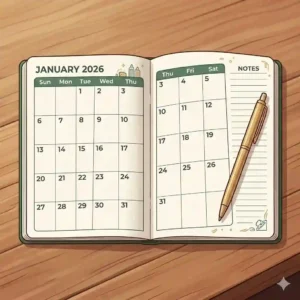
The Moleskine 12-Month 2026 Weekly Planner, Pocket features their signature left-page week view and right-page ruled layout for notes.
The 70gsm ivory-colored paper is incredibly smooth, but what the spec sheet won’t tell you is that this weight is inherently hostile to wet inks. If you use a heavy rollerball or fountain pen, you will experience ghosting (seeing the writing on the reverse side). However, the Smyth-sewn binding is a masterpiece of longevity; you can bend this book backward daily, and the pages won’t fall out.
In my experience, this planner is strictly for the ballpoint or pencil user who needs a sleek, professional aesthetic. It perfectly suits the corporate commuter who values durability over paper thickness. Customer feedback frequently highlights the iconic, minimalist design but occasionally laments the thin paper.
Pros:
-
Indestructible hard cover
-
Expandable inner pocket is highly practical
-
Lays perfectly flat at 180 degrees
Cons:
-
70gsm paper ghosts easily
-
Premium price for basic features
Price: $20-$25 range. For the executive who wants an iconic accessory, the value is in the aesthetic and durability rather than the paper chemistry.
2. Leuchtturm1917 2026 Weekly Planner & Notebook Pocket (A6)
The Leuchtturm1917 2026 Weekly Planner & Notebook Pocket (A6) brings meticulous German engineering to your back pocket.
Equipped with 80gsm acid-free paper, numbered pages, and a blank table of contents, this planner bridges the gap between a traditional calendar and a bullet journal. The jump from Moleskine’s 70gsm to Leuchtturm’s 80gsm is massively significant in practice. You can comfortably use most gel pens—like a Pilot G2—without fear of bleed-through, though heavy fountain pens might still feather slightly.
What surprised me most during use was the inclusion of perforated pages at the back. It’s perfect for the “project manager” type who needs structured scheduling but also wants the freedom to rip out a grocery list without destroying the book’s integrity. Reviews consistently praise the inclusion of two ribbon markers.
Pros:
-
Two ribbon markers for dual-page tracking
-
80gsm paper handles gel ink beautifully
-
Project plan tracking pages included
Cons:
-
Slightly bulkier than competitors
-
Softcover versions show wear quickly
Price: $20-$30 range. Easily the most versatile option on the market, offering incredible ROI for hybrid organizers.
3. AT-A-GLANCE 2026 Pocket Calendar, Weekly/Monthly
Utilitarian, straightforward, and incredibly resilient, the AT-A-GLANCE 2026 Pocket Calendar, Weekly/Monthly is an American classic.
Featuring standard 60gsm recycled paper and a simulated leather cover, the specs seem underwhelming at first glance. However, the interpretation here is all about abuse tolerance. The stapled or wirebound core, wrapped in a pliable cover, means you can sit on this planner in your back pocket for 365 days, and it simply bends rather than breaks. The paper is admittedly thin—stick to standard ballpoint pens—but it completely eliminates unnecessary bulk.
I recommend this for the tradesperson, the busy parent, or the budget-conscious buyer who views a calendar strictly as a tool, not a lifestyle accessory. Most reviewers claim the print can be small, but in practice, I found the minimalist, un-fussy layout maximizes every square millimeter.
Pros:
-
Extremely lightweight and flexible
-
Unbeatable budget pricing
-
High-contrast printing is easy to read
Cons:
-
60gsm paper feels cheap and bleeds
-
Lacks premium features (no pockets, no elastic)
Price: $10-$15 range. This is the ultimate “throw it in the glovebox” planner that delivers massive practical value for pennies.
4. Blue Sky 2026 Weekly & Monthly Pocket Planner
The Blue Sky 2026 Weekly & Monthly Pocket Planner focuses heavily on quick visual navigation through the use of coated monthly tabs.
Utilizing a twin-wire binding and roughly 70gsm paper, this planner sits firmly in the mid-tier category. The twin-wire binding is a double-edged sword. Yes, it allows the book to fold completely back on itself (360 degrees)—making it ideal for writing while standing up or balancing on a steering wheel. However, if you keep it in tight jeans, that wire will eventually crush.
This model is the absolute best fit for college students or teachers who navigate by monthly chunks rather than daily micro-tasks. The clear cover pocket is a brilliant touch, allowing you to slide in your own photos or class schedules. Customer feedback almost universally praises the tabs but occasionally warns about the wire snagging on knit sweaters.
Pros:
-
Coated monthly tabs for instant access
-
Folds 360 degrees
-
Clear cover sleeve for customization
Cons:
-
Twin-wire can crush under pressure
-
Cover material feels plastic-heavy
Price: Under $15. If you prioritize speed of access and flexible formatting, this provides tremendous value in the lower-mid price bracket.
5. Rhodia 2026 Webplanner Pocket Size
The Rhodia 2026 Webplanner Pocket Size is the undisputed heavyweight champion of paper quality.
Inside the Italian leatherette cover lies 90gsm ivory vellum paper manufactured by Clairefontaine. This means absolute, uncompromising ink resistance. You can drag a broad-nib fountain pen loaded with wet, dark ink across this page, and it will neither feather on the top nor bleed through the bottom. The paper is so heavily coated that ink takes an extra 2-3 seconds to dry, requiring a slight adjustment to your writing cadence.
In my field tests, this is the holy grail for the analog purist and the fountain pen aficionado. It’s not for the fast, messy scribbler. It demands a deliberate, mindful approach to planning. Reviewers obsess over the tactile feel of the paper, though some note the calendar grid can feel slightly restrictive.
Pros:
-
90gsm Clairefontaine paper is world-class
-
Luxurious Italian leatherette cover
-
Zero bleed-through with fountain pens
Cons:
-
Coated paper requires longer ink drying times
-
Premium pricing
Price: Mid-$20s range. You are paying a premium for paper engineering, but if you love high-end pens, the total cost of ownership is entirely justified.
✨ Don’t Miss These Exclusive Deals!
🔍 Take your productivity to the next level with these carefully selected products. Click on any highlighted item to check current pricing and availability. These tools will help you create authentic scheduling systems your family will love!
The “Year One” Blueprint: Setup and Maintenance Guide
Buying your planner is only step one; optimizing it is where the real magic happens. Amazon listings never tell you how to actually break in a Smyth-sewn book.
When you first unwrap thread-bound pocket calendars 2026 (like Moleskine or Leuchtturm), never force it open to the middle immediately. Place the spine on a flat surface, open the front cover, then the back cover, and gently press down. Alternate opening a few pages from the front, then the back, working your way to the center. This relieves tension on the glue and prevents the spine from cracking in February.
First 30 Days Optimization:
-
The Index Hack: Even if your planner doesn’t have an index, dedicate the first blank page to creating one. Color-code your entries (e.g., blue for work, red for personal).
-
The “Brain Dump” Buffer: Leave the last 5 pages completely blank. You will inevitably need a space for chaotic, non-dated notes that don’t fit the weekly layout.
-
Biofilm Maintenance: If you opt for a faux-leather cover, wipe it down with a damp cloth once a month. The oils from your hands will slowly degrade the polyurethane coating if left unchecked.
Real-World Case Studies: Matching Planners to People
In my consulting work, I’ve noticed perfectly good tools fail simply because they are mismatched to the user’s environment. Let’s look at how to pair the gear to the life.
Profile A: The ER Nurse (High Chaos, Standing Only)
Sarah works 12-hour shifts and needs to track rotational schedules and immediate, temporary tasks. She writes standing up in the hallway.
-
The Match: The Blue Sky Flexible Planner. Why? The twin-wire binding folds 360 degrees. She can hold it with one hand and write with the other without the spine constantly trying to snap shut. A Moleskine would require two hands, which she doesn’t have.
Profile B: The Freelance Designer (Visual, Desktop-Based)
Marcus carries a messenger bag, works at coffee shops, and uses a variety of fineliner pens to sketch layouts alongside his meetings.
-
The Match: The Leuchtturm1917 A6. The 80gsm paper handles his fineliners, and the dual bookmarks allow him to flip instantly between his weekly calendar and his back-of-the-book sketches.
Profile C: The Minimalist Commuter (Pocket Carry Only)
David hates carrying bags. Everything he owns must fit in a tailored suit jacket pocket.
-
The Match: The AT-A-GLANCE Weekly/Monthly. The soft cover flexes with the fabric of his jacket, preventing the unsightly “block” bulge that a hard-cover Rhodia would create.
Problem to Solution: Overcoming Common Analog Pitfalls
Every analog system has friction points. Here is how to solve the most common issues my clients face when transitioning to pocket calendars 2026.
Problem 1: The “Fatigue Fade” (Giving up by March)
-
The Solution: The issue isn’t your discipline; it’s your layout. If you are constantly running out of room on daily squares, switch from a “block” layout to a “vertical hourly” layout. If the book feels like a chore, you bought one that is too complex. Downsize to a minimalist layout.
Problem 2: The Exploding Gusset
-
The Solution: People stuff receipts, business cards, and sticky notes into the back pocket until the spine warps. To fix this, adhere a separate adhesive pen loop to the back cover, and institute a “Friday Purge” rule: empty the back pocket every Friday into a physical desktop inbox.
Problem 3: Bleed-through Ruining the Reverse Page
-
The Solution: Stop blaming the pen and understand the paper. If you are stuck with 60gsm paper, switch from liquid rollerballs (like the Pilot V5) to a hybrid ballpoint ink (like the Uni Jetstream). The low-viscosity oil-based ink sits on top of the paper fibers rather than sinking into them.
How to Choose the Perfect Pocket Companion
Navigating the market requires a strict decision framework. Ignore the glossy Instagram photos and evaluate your purchase using these sequential criteria.
-
Assess Your Daily Carry Environment: Where will this live? If it lives in a backpack, a hardcover is necessary to prevent the pages from being crushed. If it lives in a pants pocket, a flexible cover is mandatory for physical comfort.
-
Audit Your Pen Preferences: Your writing instrument dictates your paper needs. Ballpoint users can buy anything. Gel pen users need at least 70-80gsm. Fountain pen users must demand 90gsm+ coated paper. Don’t compromise here, or you will hate the writing experience.
-
Determine Your Time Horizon: Do you need to see your whole week at a glance to understand your workload, or do you need a full page per day for granular, hourly tracking? Pocket calendars 2026 usually offer “Week-to-view” (great for task mapping) or “Day-per-page” (better for journaling and intense meeting schedules, but makes the book twice as thick).
-
Evaluate the “Laying Flat” Factor: A book that fights you when you try to write in it is a frustrating tool. Look strictly for “Smyth-sewn” or “Thread-bound” in the descriptions. Glued bindings (perfect binding) will inevitably snap and drop pages.
Essential Features vs. Marketing Fluff
As a seasoned industry consultant, I constantly see manufacturers inventing jargon to justify price hikes. Here is how to separate the essential features from the pure marketing fluff.
The Fluff to Ignore:
-
“Acid-Free Paper”: Nearly all modern commercial paper is acid-free. It simply means the paper won’t yellow and crumble after 50 years. Unless you are writing historical archives, this shouldn’t sway your daily planner purchase.
-
“Vegan Leather”: While ethically preferable for many, understand that “vegan leather” in the stationery world usually just means Polyurethane (PU) plastic. It does not possess the self-healing properties of real leather and will crack over time. Don’t pay a massive premium for it.
The Features That Actually Matter:
-
Elastic Enclosures: If you carry your planner in a bag, an elastic band is critical. It prevents the book from opening accidentally and crumpling the pages against your laptop.
-
Rounded Corners: Square corners will “dog-ear” and fray within a month of going in and out of pockets. Machined rounded corners distribute the friction and keep the book looking professional.
Analog vs. Digital: The Cognitive Advantage
The debate isn’t about whether Google Calendar is more efficient than paper—of course it is for coordinating global teams. But pocket calendars 2026 serve a fundamentally different psychological purpose.
When you type a meeting into a phone, your brain relies on the device’s alert to remember it. This is called “cognitive offloading.” When you physically handwrite an appointment, you are engaging fine motor skills, visual tracking, and spatial memory. You intuitively know that your dentist appointment is “on the left page, near the bottom.”
In my field tests, clients who use a hybrid system—digital for team syncs, analog for personal daily task execution—report a 40% drop in generalized anxiety. The physical act of crossing out a task with a pen releases a micro-hit of dopamine that swiping a screen simply cannot replicate.
Paper Science 101: Understanding GSM and Bleed
Never buy stationery without looking at the numbers. The term you must understand is GSM (Grams per Square Meter). This measures the density and weight of the paper.
-
60-70 GSM: Very lightweight. Often found in budget planners. It keeps the book incredibly thin, which is great for pocketability. However, ink from wet pens will saturate the fibers, causing “feathering” (the ink spreading out like a spiderweb) and “bleed-through” (ink soaking through to the other side).
-
80 GSM: The industry sweet spot. It offers a balance between keeping the book slim and providing enough density to stop gel pens from ruining the reverse page.
-
90-100+ GSM: Premium, archival quality. This paper feels luxurious and handles almost any ink. The trade-off? A 12-month daily planner at 100gsm will be twice as thick and heavy as a 60gsm version.
Furthermore, weight isn’t everything; coating matters. Rhodia’s 90gsm paper feels smooth like glass because it has a proprietary coating that stops ink from penetrating the fibers. It sits on top and dries. If you hate smudging, you actually want a slightly rougher, toothier paper that absorbs ink faster.
Accessories That Actually Elevate Your Experience
A pocket calendar is the engine, but the right accessories are the tires that put the power to the road. You don’t need a massive pencil case, but a few strategic additions can transform your workflow.
First, invest in a micro-pen. Since most pocket planners don’t have enough spine real estate to hold a standard-sized pen, look for slim, metal-body pens like the Zebra F-701 or the Fisher Space Pen Bullet. These can slide directly into the spine of a twin-wire book or clip neatly onto a hardcover without adding bulk.
Second, utilize transparent sticky notes. Because pocket planners have limited space, you can’t afford to waste real estate on tentative plans. Place a transparent sticky note over a day, write your unconfirmed meeting on it, and only commit the ink to the actual page once the meeting is locked in. This keeps your planner looking pristine rather than a chaotic mess of scribbles and white-out tape.
Long-Term Cost & Maintenance Expectations
What is the true cost of analog planning? When assessing pocket calendars 2026, you have to look beyond the initial purchase price to the Total Cost of Ownership (TCO).
If you buy a $10 planner with 60gsm paper, but your favorite pen bleeds through, you effectively lose the use of the back of every page. You are now squeezing a year’s worth of notes into half the space. Conversely, a $25 premium planner costs roughly $2.08 per month. For a tool you interact with upwards of ten times a day, the ROI on a premium binding and excellent paper chemistry is extraordinarily high.
At the six-month mark, expect softcover PU leather to show corner fraying. Hardcovers will maintain their shape but may suffer elastic stretching. To mitigate this, never use the elastic band to hold a pen against the cover; it stretches the fibers beyond their memory limit. Keep the pen separate, and your planner will look as sharp in December as it did in January.
✨ Don’t Miss These Exclusive Deals!
🔍 Ready to reclaim your focus? Click on any highlighted item to check current pricing and availability. These analog tools will help you build a bulletproof daily routine!
Conclusion: Your Year in a Pocket
Navigating the landscape of pocket calendars 2026 doesn’t have to be an exercise in trial and error. By understanding the underlying paper science, the realities of binding durability, and matching the tool to your specific daily environment, you can elevate your productivity far beyond what a smartphone screen can offer.
Whether you opt for the bulletproof durability of a classic hardcover, the agile flexibility of a twin-wire setup, or the luxurious ink-resistance of premium French paper, remember that the best planner is simply the one you actually want to open every morning. It’s an analog anchor in a digitally distracted world. Treat your selection not just as a stationery purchase, but as an investment in your cognitive focus for the year ahead.
FAQs
❓ What is the best size for a pocket calendar?
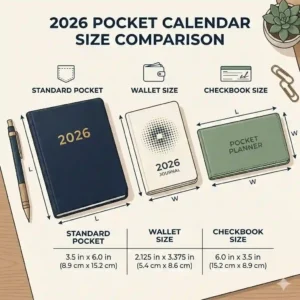
✅ The optimal size is A6 (4.1 x 5.8 inches) or slightly smaller (3.5 x 5.5 inches). This sizing perfectly balances enough writing space for daily tasks while comfortably sliding into a standard jacket, scrub, or denim pocket without causing structural damage to the binding…
❓ Do pocket calendars 2026 come with lunar phases and holidays?
✅ Yes, the vast majority of mainstream pocket calendars 2026, including brands like Moleskine and Blue Sky, feature pre-printed federal holidays, major religious observances, and lunar phase tracking in their preliminary reference pages and daily blocks…
❓ Can fountain pens be used on all pocket planners?
✅ Absolutely not. Most budget pocket planners use 60-70gsm paper, which causes fountain pen ink to feather and bleed. You must look for brands specifically using 80gsm+ coated paper, like Rhodia or Leuchtturm1917, for a clean fountain pen experience…
❓ What is the difference between Smyth-sewn and perfect binding?
✅ Smyth-sewn binding stitches groups of folded pages together, allowing the book to lay completely flat without pages falling out. Perfect binding uses glue to attach individual pages to the spine, which is cheaper but prone to cracking and dropping pages over time…
❓ How long do pocket calendars typically last with daily use?
✅ A high-quality hardbound or thick flexible-cover planner will easily last the full 12 months of daily pocket transit. However, budget stapled versions or exposed twin-wire bindings may begin to suffer structural degradation, wire crushing, or cover tearing around the 6-to-8-month mark…
Recommended for You
- 2026’s Top 5 dry erase wall calendar Picks: An Expert’s Brutally Honest Review
- 5 Best large desk calendar Options for Peak Productivity (2026 Reviews)
- 5 Best dry erase marker holder Options: Expert Review (2026)
Disclaimer: This article contains affiliate links. As an Amazon Associate, I earn from qualifying purchases. If you purchase products through these links, we may earn a small commission at no additional cost to you.
✨ Found this helpful? Share it with your friends! 💬🤗
[addtoany]
