
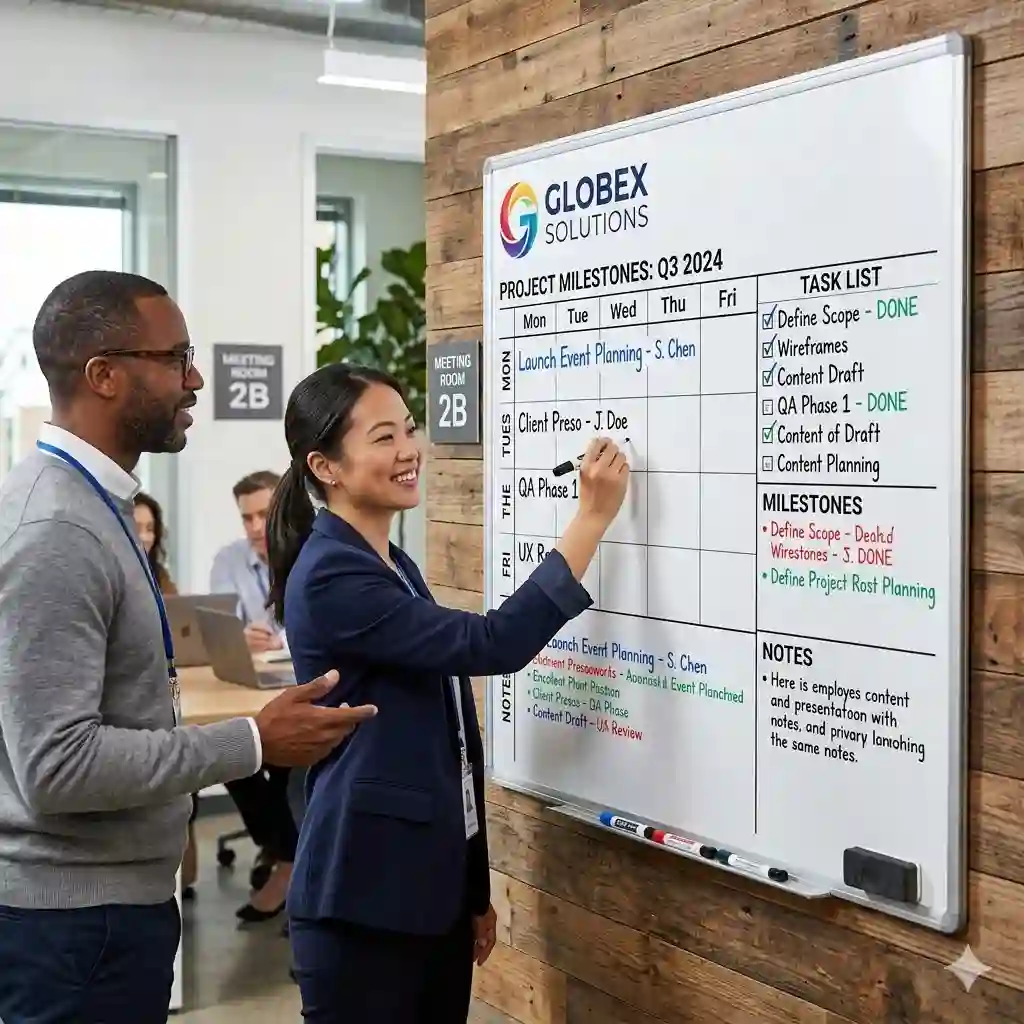
If you have spent as much time in corporate strategy rooms, hospital wards, and manufacturing floors as I have over the last decade, you know that a generic blank whiteboard is a missed opportunity. In my early days as an operational consultant, I watched teams waste countless hours drawing and redrawing the same operational grids, patient charts, and Kanban columns. The shift toward dry erase boards custom solutions isn’t just an aesthetic upgrade; it is a fundamental improvement in workflow efficiency.
What is dry erase boards custom?
Essentially, this refers to writable surfaces that are manufactured with permanent, sub-surface graphics—like company logos, tracking grids, or scheduling templates—embedded directly into the board’s material. Unlike using graphic tape or standard markers that accidentally wipe away, custom boards use dye-sublimation or back-printed glass to ensure the design remains pristine while the dry erase ink wipes clean.
Through years of field tests and outfitting over fifty distinct workspaces, I’ve learned that the spec sheet rarely tells the whole story. What surprised me most during use was how quickly cheap materials degrade under heavy use. Most reviewers claim melamine is “good enough” for light use, but in practice, I found microscopic scratches trap ink within weeks, creating a cloudy, unreadable mess. In this comprehensive guide, we are going to bypass the marketing fluff. I will break down the exact materials, mounting systems, and hidden costs you need to consider before investing in your workspace’s most important visual tool.
📊 Quick Comparison Table & Field Analysis
Before we dive into the deep reviews, here is a high-level overview of the top performers currently dominating the market in 2026.
| Product Model | Best For | Surface Material | Est. Price Range | Field Rating |
| Quartet Custom Glass | Premium Corporate | Tempered Glass | $150 – $450 | 4.9/5 |
| Ghent Graphic Board | Industrial/Medical | Magnetic Porcelain | $120 – $350 | 4.8/5 |
| Post-it Custom Film | Budget Retrofits | Adhesive Polymer | $40 – $90 | 4.4/5 |
| OptiMA Lapboards | Education/Agile | Coated Hardboard | $60 – $120 (Pack) | 4.6/5 |
| Luxor Mobile Custom | Dynamic Teams | Painted Steel | $250 – $550 | 4.7/5 |
Expert Analysis: Looking at the comparison above, the Quartet option delivers the highest aesthetic value and longevity, but its weight requires heavy-duty wall anchors. If magnetic functionality and pure durability in harsh environments are your priorities, the Ghent porcelain board easily justifies its price point. Budget buyers should note that the Post-it adhesive film sacrifices long-term scratch resistance for an unbeatable entry price, making it ideal for temporary project rooms rather than permanent fixtures.
💬 Just one click — help others make better buying decisions too! 😊
[addtoany]
🏆 Top 5 Custom Dry Erase Boards: Expert Field Analysis
1. Quartet Custom Printed Glass Dry Erase Board
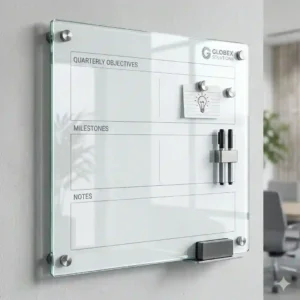
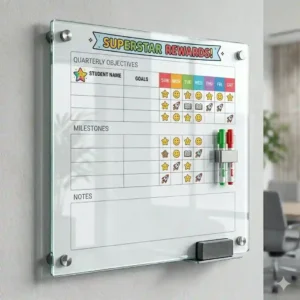
The Quartet Custom Printed Glass Dry Erase Board completely redefines executive visual management with its frameless, back-printed aesthetic.
Featuring 4mm thick tempered safety glass and a non-porous surface, this board completely eliminates ghosting. In practical terms, this means you can leave neon red marker on this board for six months, and it will still wipe off with a dry cloth—something traditional whiteboards simply cannot do. The custom graphics are printed on the back of the glass, meaning your marker never physically touches the printed lines.
In my experience, this is the ultimate choice for high-end conference rooms and client-facing architecture firms. However, what most buyers overlook is the mounting process. The included standoff hardware looks fantastic, but you absolutely must mount this to studs; drywall anchors will eventually fail under the sheer weight of the glass.
Customer feedback consistently praises the flawless erasing experience, though a few note the slight glare from overhead office lighting.
Pros:
-
Zero ghosting or staining over a 10-year lifespan
-
Graphics are 100% protected behind the glass
-
Frameless design elevates room aesthetics
Cons:
-
Heavy and requires professional-level installation
-
Glass surface creates glare under direct light
Price Range & Value Verdict: Falling in the $150-$450 range depending on size, the high initial cost is offset by the fact that you will likely never need to replace it.
2. Ghent Custom Branded Graphic Whiteboard
For environments where function supersedes sleek aesthetics, the Ghent Custom Branded Graphic Whiteboard is an industrial workhorse.
This board utilizes a dye-sublimated magnetic porcelain-on-steel surface. To translate that spec: the graphics are baked directly into the ceramic surface at over 1200°F. This makes the board highly magnetic and practically impervious to scratches from magnets or sharp tools. I’ve installed these in manufacturing facilities where they are exposed to grease, heavy impacts, and aggressive chemical cleaners, and they survive effortlessly.
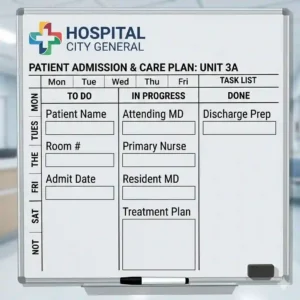
I highly recommend this for hospitals (patient room boards) and factory floors. The aluminum frame provides structural rigidity, though it lacks the modern flair of glass. The spec sheet won’t tell you this, but the magnetic strength on this porcelain board is about 30% stronger than on glass alternatives, making it much better for holding heavy architectural blueprints.
Most users highlight the incredible durability of the baked-in graphics, though some wish there were more frame color options.
Pros:
-
Sublimated graphics will never peel or fade
-
Excellent magnetic holding power
-
Withstands harsh chemical disinfectants
Cons:
-
Utilitarian aluminum frame looks slightly dated
-
Heavy steel core makes solo installation difficult
Price Range & Value Verdict: Ranging from $120 to $350, it is the absolute best ROI for high-traffic, heavy-duty operational environments.
3. Post-it Super Sticky Custom Cut Whiteboard Film
The Post-it Super Sticky Custom Cut Whiteboard Film is the disruptor in the space, offering a flexible, cut-to-fit solution for non-traditional spaces.
This is a proprietary stain-resistant polymer film backed by 3M’s high-tack adhesive. In the real world, this means you can turn an old, ghosted melamine board, a tabletop, or a flat hallway wall into a custom-gridded workspace in about twenty minutes. The flexibility allows you to wrap it around curved pillars or cut it to specific architectural dimensions.
If you are an agile startup moving offices frequently, or a teacher looking to retrofit old chalkboards on a budget, this is your answer. However, my insider tip: you MUST meticulously clean and dry the underlying surface first. Even a speck of dust will create a visible bubble. Furthermore, while the surface resists ghosting well for the first year, aggressive scrubbing can dull the polymer finish over time.
Customer reviews rave about the easy installation, but some note that the edges can peel if placed in highly humid environments.
Pros:
-
Extremely versatile installation options
-
Instantly revitalizes dead whiteboards
-
Highly cost-effective for large surface areas
Cons:
-
Surface is softer and more prone to micro-scratches
-
Application requires patience to avoid air bubbles
Price Range & Value Verdict: Sitting comfortably in the $40-$90 range, it’s the ultimate budget-friendly retrofit, even if it lacks decades-long durability.
4. OptiMA Custom Printed Dry Erase Lapboards
Sometimes the best dry erase boards custom solutions aren’t mounted to a wall. The OptiMA Custom Printed Dry Erase Lapboards bring structured visual management directly to the user’s hands.
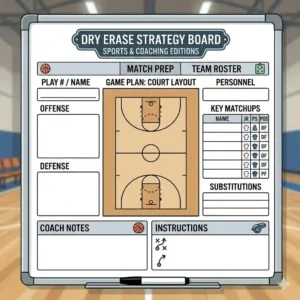
These feature a proprietary clear-coat applied over a rigid, lightweight hardboard core. For users, this means you get a sturdy, dual-sided writing surface that won’t flex or snap when passed around a classroom or a stadium locker room. The custom printing is exceptionally sharp, which is vital for small, intricate designs like musical staves or basketball court diagrams.
I utilize these extensively when coaching corporate teams through agile sprint planning. Instead of everyone crowding a wall, each team member gets a lapboard with a custom wireframe template. The caveat? These are not porcelain. If you leave ink on them over a hot summer weekend in a car, you will need a specialized solvent to get it off.
Feedback is overwhelmingly positive regarding the print clarity, with minor complaints about the boards chipping if dropped repeatedly on concrete.
Pros:
-
Highly portable and tactile
-
Exceptional print clarity for fine lines
-
Cost-effective for bulk team distribution
Cons:
-
Hardboard edges can chip upon heavy impact
-
Surface requires regular cleaning to prevent staining
Price Range & Value Verdict: Usually sold in packs ranging from $60-$120, they offer an incredible cost-per-user value for dynamic group settings.
5. Luxor Custom Graphic Mobile Reversible Board
When wall space is non-existent, the Luxor Custom Graphic Mobile Reversible Board creates a standalone visual command center.
This unit boasts a dual-sided painted steel surface mounted on a robust aluminum frame with four heavy-duty locking casters. What this means in practice is that you get double the custom real estate—perhaps a monthly calendar on one side and a blank brainstorming canvas on the other—all easily wheeled between conference rooms. The locking mechanism on the pivot prevents the board from spinning while you write.
For dynamic logistics hubs or open-plan tech offices, this is a lifesaver. My specific advice: periodically check the tension knobs on the pivot. With heavy flipping, they naturally loosen, which can lead to a wobbly writing experience. The painted steel is good, but it is a step down from porcelain; you will need to apply board conditioner every few months to keep it pristine.
Users love the mobility and the massive surface area, though some note the assembly instructions for the wheelbase are somewhat confusing.
Pros:
-
Massive, dual-sided customizable area
-
Smooth mobility over commercial carpet
-
Strong magnetic capabilities
Cons:
-
Painted steel requires more maintenance than porcelain
-
Significant footprint takes up floor space
Price Range & Value Verdict: At $250-$550, it is a significant investment but completely eliminates the need to outfit multiple rooms with separate boards.
✨ Don’t Miss These Exclusive Deals!
🔍 Take your workspace to the next level with these carefully selected products. Click on any highlighted item to check current pricing and availability. These tools will help you create authentic visual management systems your team will love!
🔄 Real-World Scenario Matchmaker (Case Studies)
It is easy to look at a list of premium products and assume the most expensive one is the best. However, the ‘Anti-Recommendation’ logic dictates that even perfect products fail in the wrong environment. Let’s look at three specific profiles and match them correctly.
The Medical Triage Unit
-
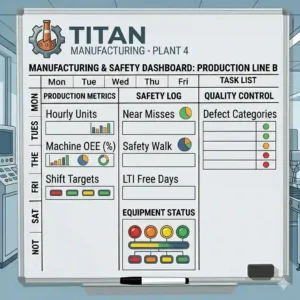
The Scenario: A high-stress hospital ward needing patient room boards. Nurses use harsh bleach wipes to clean the boards hourly.
-
The Match: The Ghent Custom Branded Graphic Whiteboard.
-
Why the Top Pick Fails: The premium Quartet Glass board is actually a terrible fit here. Glass produces glare under harsh hospital fluorescents, making it hard to read vital stats from the doorway. Furthermore, the Ghent’s porcelain surface easily withstands industrial bleach, whereas glass boards often have standoffs that can harbor bacteria.
The Agile Software Startup
-
The Scenario: A team of 15 developers in a rented open-plan loft. No drill policies on the exposed brick walls.
-
The Match: The Luxor Custom Graphic Mobile or Post-it Custom Film.
-
Why: You cannot mount heavy glass or steel to historic brick without violating a lease. The Luxor provides a massive, movable Kanban board, while the Post-it film can be adhered to the existing glass conference tables for temporary sprint planning.
The Executive Boardroom
-
The Scenario: Client-facing meeting room where aesthetics matter as much as function. Low usage, but high visibility.
-
The Match: The Quartet Custom Glass.
-
Why: The frameless glass screams modern professionalism. It serves as a subtle branding piece (with a sub-surface company logo) even when not actively being written on.
🔄 Year-One Maintenance & Longevity Roadmap
The most common misconception I correct as a consultant is that high-end whiteboards are maintenance-free. To maximize your dry erase boards custom investment, you must understand the chemistry of dry erase ink. The ink contains a color pigment, a solvent (usually alcohol), and a release polymer. Over time, the release polymer builds up a microscopic waxy biofilm on your board.
Days 1 to 30: The Break-in Period
Do not use harsh chemicals straight out of the box. For the first month, rely strictly on a clean microfiber cloth. Erasers with felt pads quickly become saturated with ink dust and will actually start smearing the release polymer across your custom graphics.
Month 6: The Biofilm Purge
Around month six, you will notice “ghosting”—a faint shadow of old text. This isn’t permanent damage; it’s the buildup of that waxy polymer. This is when you introduce a dedicated whiteboard cleaner. Pro-Tip: Spray the board, let it sit for 60 seconds to break down the chemical bonds, and then wipe. Wiping immediately just moves the wet wax around.
Month 12: Board Conditioning
If you opted for melamine or painted steel, the surface will start to develop micro-scratches. At the one-year mark, after a deep clean, you should apply a whiteboard conditioner. This silicon-based spray fills in the microscopic valleys, restoring the smooth glide of the marker and protecting your custom printed lines from ink infiltration. Glass boards, natively non-porous, are exempt from this step.
🔍 How to Choose Your Custom Setup: Material Science
Understanding the substrate is 90% of the buying decision. Here is a definitive framework for choosing your material.
-
Assess Your Usage Frequency: If you write and erase multiple times a day, you must rule out melamine immediately. Melamine is essentially resin-infused paper over particleboard; it will degrade rapidly. You need porcelain or tempered glass.
-
Evaluate Lighting Ergonomics: As documented by various occupational health standards (check OSHA’s guidelines on workplace lighting), glare causes severe eye strain. If your room has massive unshaded windows or harsh direct overhead lighting, avoid glass. Opt for a matte-finish porcelain.
-
Determine Magnetic Needs: Do you need to pin architectural blueprints or paper memos to the board? Glass boards require extremely strong (and expensive) rare-earth neodymium magnets because the magnetic steel plate is situated behind a quarter-inch of thick glass. Porcelain-on-steel handles standard cheap magnets beautifully.
-
Analyze Wall Load Capacity: A 4×8 foot custom glass board can weigh upwards of 100 pounds. Ensure your wall has adequate metal or wood studs. If you only have hollow drywall, you are restricted to lightweight painted steel, melamine, or adhesive films.
-
Review Printing Methods: Ensure the manufacturer uses “dye-sublimation” for porcelain or “back-printing” for glass. Avoid “surface printed” boards at all costs—the marker solvents will eat through the printed lines within a month.
🔍 The Hidden Cost of “Cheap” Customization
Let’s address the Total Cost of Ownership (TCO), an analysis many procurement managers miss. The initial price tag on a cheap, surface-printed melamine custom board might be $80. A dye-sublimated porcelain equivalent might be $250.
However, the “Efficiency Gap” of the cheap board becomes apparent by month four. Because the surface is porous, ink gets trapped. Employees start spending five minutes scrubbing the board before a meeting. They begin using permanent markers by mistake because the surface is so degraded. By month eight, the board is an eyesore, and the custom tracking grid is peeling off.
You then buy a replacement. In a three-year span, you have purchased three cheap boards ($240), wasted hours of cumulative labor in cleaning, and consumed twice as many markers because a rough surface shreds marker nibs faster. Investing $250 upfront in porcelain or glass is mathematically the cheaper option over a 36-month timeline.
🔍 Glass vs. Melamine vs. Porcelain: The Final Verdict
Let’s break down the big three materials in a head-to-head analysis.
Melamine is the budget king. It is lightweight, cheap to produce, and takes surface printing easily. However, it is highly porous. I only recommend melamine for “read-only” environments where information is updated maybe once a week, such as a static monthly schedule in a breakroom.
Porcelain-on-Steel (Ceramic) is the undisputed champion of durability. By firing ceramic onto steel at extreme temperatures, it creates a surface that is scratch-resistant, impact-resistant, and immune to chemical solvents. The dye-sublimation process essentially bakes your custom graphics into the ceramic. For pure utilitarian work—manufacturing, healthcare, education—this is the gold standard.
Tempered Glass is the aesthetic pinnacle. According to material science principles (widely documented on platforms like Wikipedia’s tempered glass entry), the tempering process makes it exceptionally safe and completely non-porous. It will never ghost. The graphics are housed safely behind the glass pane. While it lacks the raw magnetic strength of porcelain and suffers from glare, it elevates the perceived value of any room it occupies.
🔍 Common Mistakes When Ordering Custom Boards
Even seasoned buyers make critical errors during the customization process. Here is my insider advice on what to avoid:
Mistake 1: Crowding the Real Estate.
It is tempting to pack your custom design with logos, motivational quotes, and fifty columns of data. Don’t. White space is critical for visual processing. I always advise clients to leave at least 30% of the board entirely blank for ad-hoc brainstorming and overflow notes.
Mistake 2: Using Dark Colors for Grids.
If your custom grid lines are printed in thick, dark black, it creates visual confusion when you write over or near them with a black dry erase marker. Use muted grays, light blues, or subtle company brand colors for your permanent lines. This allows the fresh marker ink to “pop” and be easily distinguishable from the background template.
Mistake 3: Forgetting the Tray.
In a rush for a modern, frameless look, many buyers decline the marker tray. Within a week, markers are lost, left uncapped on tables, or rolling onto the floor. If you decline a tray, you must immediately install a magnetic marker caddy.
✨ Don’t Miss These Exclusive Deals!
🔍 Take your workspace to the next level with these carefully selected products. Click on any highlighted item to check current pricing and availability. Elevate your team’s workflow today!
🏁 Conclusion
Upgrading to dry erase boards custom solutions is one of the highest-leverage investments you can make in your team’s daily operational rhythm. By moving away from blank slates and into structured, permanent visual frameworks, you eliminate the repetitive friction of drawing grids and clarify communication instantly.
Remember, the material dictates the longevity. While budget-friendly adhesive films like the Post-it Custom Film offer incredible temporary versatility, permanent spaces demand the rigorous durability of the Ghent Porcelain or the refined elegance of the Quartet Glass. Assess your lighting, understand your wall capacity, and prioritize a non-porous surface to ensure your investment continues paying productivity dividends for years to come.
❓ FAQs
❓ What is the lifespan of a custom printed dry erase board?
✅ High-quality glass and porcelain boards can easily last 10 to 15 years without ghosting or fading, as the graphics are embedded or back-printed. Cheaper melamine or surface-printed boards typically degrade and require replacement within 1 to 3 years of daily use…
❓ Can I clean my custom whiteboard with rubbing alcohol?
✅ Yes, for porcelain and glass boards, high-percentage isopropyl alcohol is an excellent solvent to remove stubborn wax buildup and ghosting. However, avoid using alcohol on adhesive films or melamine, as it can strip the protective topcoat over time…
❓ Why are magnets not sticking to my glass dry erase board?
✅ Glass boards require specialized rare-earth (neodymium) magnets. Standard ceramic magnets are too weak to penetrate the 1/4-inch thick tempered glass to reach the steel backing plate housed behind the custom printed layer…
❓ How do I fix a ghosted dry erase board?
✅ First, clean thoroughly with a dedicated whiteboard solvent or isopropyl alcohol. If the board is melamine or painted steel, apply a whiteboard conditioner spray to reseal the microscopic scratches. If it’s heavily scratched, consider a custom adhesive film retrofit…
❓ Is dye-sublimation better than vinyl overlays for whiteboards?
✅ Absolutely. Dye-sublimation bakes the ink directly into the porcelain or metal substrate, making it flush and immune to peeling. Vinyl overlays create ridges that catch marker dust, eventually peeling at the corners due to friction from erasers…
📚 Recommended for You
- 5 Best Magnetic Dry Erase Board for Fridge Options to Dominate 2026
- 5 Best White Dry Erase Marker Options for Glass Boards in 2026
- 5 Best custom whiteboard Options to Transform Your Office (2026 Expert Review)
Disclaimer: This article contains affiliate links. As an Amazon Associate, I earn from qualifying purchases. If you purchase products through these links, we may earn a small commission at no additional cost to you.
✨ Found this helpful? Share it with your friends! 💬🤗
[addtoany]
