
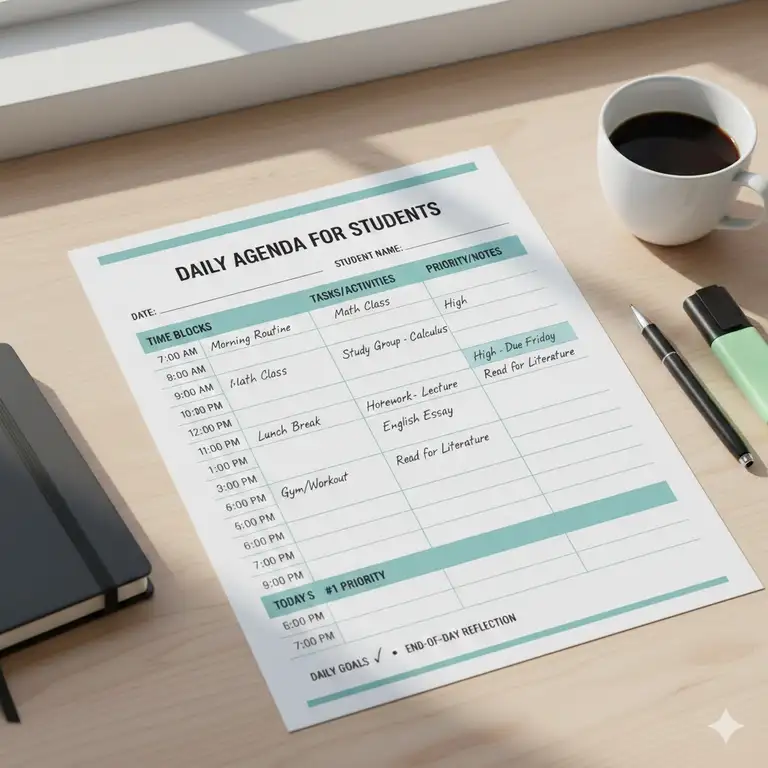
It’s the constant battle, isn’t it? As a student, you’re juggling classes, homework, extracurriculars, maybe a part-time job, and somehow, you still need to find time to eat and (gasp!) sleep. It feels like you’re always chasing the clock, with important deadlines looming like storm clouds on the horizon. The truth is, the most successful students—the ones who seem to have it all together—don’t magically have more hours in the day. They just know how to manage their existing hours brilliantly. And what’s their secret weapon? It’s a rock-solid, well-planned daily agenda for students.
✨Was this helpful? Spread the word! 🚀
A proper daily agenda for students is more than just a list of things to do; it’s a strategic roadmap for academic success and personal well-being. It transforms a chaotic mess of assignments and meetings into an organized, actionable plan. I’ve personally seen how the right organizational tools can be the difference between feeling completely overwhelmed and feeling confidently in control. It’s about setting clear priorities, sticking to a routine, and using the right tools to keep you on track. This article is your expert guide to mastering the art of the student’s daily agenda. We’ll dive into the specific tools, techniques, and, yes, even the physical products that can turn your school year from stressful to successful.
🎯 Quick Comparison: Digital vs. Physical Daily Agenda Tools
Choosing the right format for your student daily agenda is the first critical step. It really boils down to whether you thrive in a digital environment or prefer the tactile experience of paper and pen. Each approach offers unique benefits, which we’ve summarized below:
| Aspect | Digital Agenda (Apps/Software) | Physical Agenda (Planners/Notebooks) |
| Access & Portability | Universal access on phone/laptop; syncs instantly. | Requires carrying the physical book; no backup if lost. |
| Search & Organization | Powerful search, easy to re-order and categorize tasks. | Requires manual indexing; organization relies on personal handwriting/system. |
| Reminders & Alerts | Automatic push notifications and time-based alerts. | Only relies on visual checking or external phone reminders. |
| Focus & Distraction | High risk of distraction (notifications, other apps). | Dedicated tool, often promoting deep focus and less screen time. |
| Cost | Free to subscription-based premium models. | Single purchase for the year; can be highly aesthetic/premium. |
| Best For | Students with multiple devices, complex scheduling, and a need for collaborative features. | Students who learn better by writing, prefer minimalist/distraction-free work, and enjoy a tactile process. |
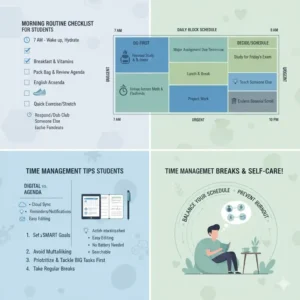
🔝 Top 7 Must-Have Tools for the daily agenda for students: Expert Analysis
To truly build an effective system for your student daily agenda, you need reliable, high-quality tools. Whether you’re looking for a dedicated physical planner to jot down your study schedule or a sophisticated digital tablet to manage an entire semester, these seven products are highly recommended by academic experts and consistently top the charts on platforms like Amazon. I’ve broken down the specifications, user feedback, and pros and cons for each one.
1. Passion Planner Classic (Undated)
The Passion Planner Classic (Undated) is a standout among physical student daily agenda tools. It’s far more than just a calendar; it’s a goal-setting system wrapped in a high-quality journal. Its structure is based on the “Passion Roadmap,” a system designed to help users break down long-term goals into monthly and weekly actionable steps.
-
Technical Specifications:
-
Size: Classic (A4/Letter size, 8.5 x 11 inches) or Compact (A5 size).
-
Binding: High-quality PU leather cover, durable sewn binding.
-
Paper Quality: 120 GSM thick paper (prevents bleed-through).
-
Layout: Includes monthly and weekly spreads, “Good Things That Happened” section, and blank pages for notes/doodling.
-
Duration: Undated, allowing the student to start anytime.
-
-
Customer Review Analysis: Users consistently praise its ability to combine goal-setting with daily planning. Many reviews mention how the “Space of Infinite Possibility” section is a great outlet for creative thinking or detailed class notes. The 120 GSM paper is frequently cited as a major positive, especially for those using fountain pens or markers. A common critique is the weight of the Classic size, which can be heavy to carry around all day.
-
Pros/Cons Analysis:
-
✅ Pros: Excellent goal integration; superior paper quality; promotes long-term strategic thinking; undated flexibility.
-
❌ Cons: Heavier and bulkier than simple notebooks; the system requires time to learn and implement fully.
-
-
Professional Application: Ideal for students studying complex subjects requiring long-term project planning, such as engineering, thesis-based humanities, or complex science labs.
2. Rocketbook Core Smart Notebook (Executive A5)
The Rocketbook Core Smart Notebook (Executive A5) revolutionizes the physical notebook experience. It offers the tactile benefit of writing by hand but with the powerful backup and organization of a digital system. This is a brilliant choice for any student who still wants to write notes but is worried about losing their precious study materials.
-
Technical Specifications:
-
Size: Executive (6 x 8.8 inches).
-
Writing Medium: Uses FriXion pens, which erase easily with a damp cloth.
-
Page Count: 32 reusable pages.
-
Digital Integration: Patented system allows users to “blast” their notes to Google Drive, Dropbox, Evernote, OneNote, Slack, or email using the Rocketbook app.
-
Layout: Dot-grid pattern for versatile note-taking, sketching, and agenda layout.
-
-
Customer Review Analysis: The magic of the reusable pages and instant cloud storage is the biggest draw. Students specifically love using it for quick lecture notes or daily agenda drafts, knowing they can clean the page and start fresh tomorrow. The main complaint is the reliance on specific FriXion pens, which must be purchased separately.
-
Pros/Cons Analysis:
-
✅ Pros: Environmentally friendly and reusable; seamless digital integration; great for quick note-taking and daily planning.
-
❌ Cons: Limited page count (only 32); requires specific pens; scanning quality is dependent on lighting.
-
-
Professional Application: Perfect for STEM students who need to capture quick calculations or equations, or art/design students who need to save sketches digitally without re-drawing.
3. Amazon Basics Weekly and Monthly Planner 2025
For students who need a straightforward, budget-friendly option, the Amazon Basics Weekly and Monthly Planner 2025 is an excellent no-frills tool for their daily agenda for students. It covers the core functionality needed to keep track of classes, deadlines, and social events without any complicated features or systems.
-
Technical Specifications:
-
Size: 8 x 10 inches.
-
Duration: Full 12-month calendar (January to December 2025).
-
Layout: Clear, non-cluttered monthly and weekly views; laminated tabs for easy navigation.
-
Paper Quality: Standard, non-coated paper.
-
Extras: Includes a dedicated contact list and future planning pages.
-
-
Customer Review Analysis: Reviewers highlight its simplicity and value. It’s often praised as the best “workhorse” planner—no unnecessary bells and whistles. A few users mentioned that the paper can be thin and prone to bleed-through with heavy markers.
-
Pros/Cons Analysis:
-
✅ Pros: Extremely affordable; very simple and easy to use; lightweight for backpack carry.
-
❌ Cons: Basic paper quality; no integrated goal-setting or specialized student features; only available as a dated model.
-
-
Professional Application: Best suited for high school students or college students with predictable schedules who primarily need an organized place to track due dates and appointment times.
4. Moleskine Smart Writing Set (Pen+Ellipsis Notebook)
The Moleskine Smart Writing Set (Pen+Ellipsis Notebook) merges the classic elegance of Moleskine notebooks with cutting-edge digital technology. It’s a premium option for students who demand the highest quality in their tools and want their handwritten notes instantly digitized. It’s a very classy approach to managing your student daily agenda.
-
Technical Specifications:
-
Pen: Moleskine Pen+ uses Neo smartpen technology.
-
Notebook: Specialized paper (NCoded technology) with almost invisible dots that allow the pen to track its exact position.
-
Connectivity: Bluetooth connection to the Moleskine Notes App.
-
Features: Transcribes handwritten text into editable digital text; allows for recording audio simultaneously with writing.
-
Battery: Rechargeable lithium-ion battery in the pen.
-
-
Customer Review Analysis: Customers rave about the near-perfect transcription and the ability to record lectures while taking notes. It’s seen as a productivity powerhouse. The primary drawback cited is the high price point and the necessity of purchasing only the specialized Moleskine Ellipsis notebooks, which are more expensive than regular paper.
-
Pros/Cons Analysis:
-
✅ Pros: Excellent transcription accuracy; audio recording feature is invaluable for lectures; premium build quality and aesthetics.
-
❌ Cons: Very high initial cost; proprietary paper is required; reliance on battery life.
-
-
Professional Application: Essential for graduate students or students with heavy lecture schedules who need reliable, searchable, and instantly editable notes for their daily agenda.
5. The Self Journal by BestSelf Co.
The Self Journal by BestSelf Co. is a 13-week productivity journal designed around the concept of time blocking and goal achievement. It’s highly focused and structured, making it an excellent tool for students who struggle with procrastination and need to maximize every hour of their day. It’s not just a student daily agenda; it’s a focused performance tool.
-
Technical Specifications:
-
Duration: 13 weeks (non-dated, but date fields must be filled in).
-
Layout: Daily sections structured for Morning Routine, Schedule (Time Blocking), Targets, and Lessons Learned.
-
Size: 5.75 x 8.25 inches (easy to carry).
-
Paper Quality: 100 GSM acid-free paper.
-
Goal Tracking: Dedicated sections for 90-Day goals broken into weekly and daily action items.
-
-
Customer Review Analysis: Users love the time-blocking structure and the daily reflection sections, which force a pause and assessment of progress. The most common complaint is the 13-week limit, meaning you need to purchase four journals for a full academic year, increasing the total cost significantly.
-
Pros/Cons Analysis:
-
✅ Pros: Excellent for developing the time-blocking skill; highly structured and goal-oriented; portable size.
-
❌ Cons: Only lasts 13 weeks; the structure can feel too rigid for students with highly variable schedules.
-
-
Professional Application: Highly recommended for first-year college students or students taking challenging “weed-out” courses who need strict discipline and focus to stay on track.
6. Apple iPad Air (5th Generation) with Apple Pencil 2
While not a dedicated planner, the Apple iPad Air (5th Generation) with Apple Pencil 2 is arguably the ultimate digital ecosystem for the modern student daily agenda. When paired with apps like Notability or GoodNotes, it becomes a powerful, infinitely customizable digital notebook and planner, allowing for handwritten notes, textbook annotations, and cloud-based scheduling.
-
Technical Specifications:
-
Chip: Apple M1 Chip (8-core CPU, 8-core GPU).
-
Display: 10.9-inch Liquid Retina display.
-
Storage: 64GB or 256GB options.
-
Apple Pencil 2 Integration: Magnetic attachment and charging; pressure and tilt sensitivity.
-
Connectivity: Wi-Fi 6, Optional 5G cellular.
-
-
Customer Review Analysis: The seamless, fluid writing experience of the Apple Pencil 2 and the versatility of the M1 chip are universally praised. Students appreciate the ability to keep all textbooks, notes, and the daily agenda for students in one lightweight device. The major downside is the significant investment required, especially when adding the Pencil and a protective case.
-
Pros/Cons Analysis:
-
✅ Pros: Unmatched versatility (notes, multimedia, research); incredibly portable; best-in-class digital handwriting experience; powerful processing.
-
❌ Cons: Very high initial cost; high risk of digital distraction (social media, games); apps may require additional cost.
-
-
Professional Application: The go-to tool for digital natives, graphic design students, or students who rely heavily on annotated PDFs and complex app integration for their coursework.
7. Trello (Digital Project Management Software)
Trello is a collaborative project management application, and though it’s not a physical planner or an Apple product, it’s an incredibly powerful tool that can serve as a highly functional, visual component of a student’s daily agenda. It uses a Kanban-style board (cards on lists) which is fantastic for organizing the massive workload of a student.
-
Technical Specifications:
-
Platform: Web-based, iOS, and Android applications.
-
Core Structure: Boards, Lists, and Cards.
-
Features: Checklists, due dates, file attachments, team collaboration, and color-coded labels.
-
Pricing: Free tier with essential features; Standard and Premium paid tiers.
-
Integrations: Connects with Slack, Google Drive, Outlook, and other major services.
-
-
Customer Review Analysis: Students love Trello’s visual nature—being able to drag a “Math 101 Homework” card from “To Do” to “Doing” to “Done” is highly satisfying and motivating. The collaboration features are excellent for group projects. The main difficulty for some is the initial learning curve to set up the board structure effectively.
-
Pros/Cons Analysis:
-
✅ Pros: Fantastic for visual learners; excellent for group projects; robust free version; highly customizable organization.
-
❌ Cons: Can become cluttered if not managed consistently; requires an internet connection for full functionality; the free version has some file size limitations.
-
-
Professional Application: Invaluable for group projects, long-term thesis management, or students with complex, multi-faceted roles in campus organizations who need to track different workflows simultaneously.
✨ Don’t Miss These Exclusive Deals! 🔍
Take your academic planning to the next level with these carefully selected products. Click on any highlighted item to check current pricing and availability. These tools will help you create a daily agenda for students that truly works!
💬 Just one click – help others make better buying decisions too!😊
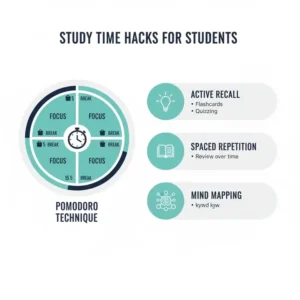
📚 Comparison Table 1: Technical Specifications Matrix (Spec Matrix)
| Product | Type | Size (Approx.) | Paper/Screen Quality | Unique Technology |
| Passion Planner Classic (Undated) | Physical Planner | 8.5 x 11 inches | 120 GSM thick paper | Passion Roadmap Goal System |
| Rocketbook Core Smart Notebook (Executive A5) | Hybrid Notebook | 6 x 8.8 inches | Reusable, poly-blended paper | FriXion pen and Cloud Sync Technology |
| Amazon Basics Weekly and Monthly Planner 2025 | Physical Planner | 8 x 10 inches | Standard Paper | Laminated Tabs and Basic Layout |
| Moleskine Smart Writing Set (Pen+Ellipsis Notebook) | Smart Writing System | Varies by notebook | NCoded specialized paper | Pen+ Digital Tracking & Transcription |
| The Self Journal by BestSelf Co. | Physical Journal | 5.75 x 8.25 inches | 100 GSM acid-free paper | 13-Week Goal-Setting and Time-Blocking System |
| Apple iPad Air (5th Generation) with Apple Pencil 2 | Digital Tablet | 10.9-inch display | Liquid Retina Display | Apple M1 Chip, Apple Pencil 2 |
| Trello | Digital Software | N/A (Web/App) | N/A | Kanban Project Management Board |
📅 The Foundation of Student Success: Why a daily agenda for students is Essential
Having a dedicated, organized student daily agenda is the single most important habit a student can develop. It’s not just about listing your homework; it’s about reducing cognitive load, which is a fancy way of saying it frees up your brain from the stress of remembering everything. When you write something down, your brain can relax and focus on the actual work.
The Psychology of Planning: Reducing Overwhelm
Students, especially those balancing complex academic workloads and social lives, often feel overwhelmed by the sheer volume of things they need to do. This “mental clutter” can lead to procrastination, anxiety, and burnout. Creating a simple daily agenda for students combats this through a psychological phenomenon known as the Zeigarnik effect, which suggests that people remember unfinished or interrupted tasks better than finished ones.
-
The Power of Completion: When you move a task from your To Do list to your Done list, you get a small hit of dopamine—a natural reward for completing a task. This positive reinforcement encourages you to tackle the next item on your student daily planner, creating a powerful cycle of productivity.
-
Time Blocking: The most effective agendas use time blocking, which involves assigning specific tasks to specific blocks of time. This addresses a common issue for students: thinking, “I have all day to work on this” when, in reality, they only have a few dedicated, distraction-free hours. When you block out, say, 7:00 PM – 9:00 PM: Study Organic Chemistry, you are mentally committing to that task, which dramatically increases the likelihood of follow-through.
Secondary Keyword Deep Dive: Maximizing the student daily planner
The term “student daily planner” is often used interchangeably with the main keyword, and it highlights a key feature: the daily aspect. A good planner doesn’t just show monthly due dates; it provides space for the day-to-day tactical execution.
The daily view is where the magic happens. It’s where you translate large assignments into small, manageable action steps. For example, instead of seeing “Essay Due Next Friday,” your student daily planner for Monday might read:
-
✅ 9:00 AM – 10:00 AM: Research 3 sources for Essay.
-
✅ 1:00 PM – 3:00 PM: Create detailed outline for Essay.
-
✅ 7:00 PM – 8:00 PM: Write Introduction paragraph.
This technique is crucial for managing big projects and avoiding the paralyzing feeling of not knowing where to start. You’re not trying to write the whole essay; you’re just writing the introduction. The simplicity of the immediate task makes it easier to start.
🛠️ Deep Dive into Agenda Structure: Crafting the Perfect daily agenda for students
Whether you opt for the digital flexibility of the Apple iPad Air (5th Generation) with Apple Pencil 2 or the tactile structure of the Passion Planner Classic (Undated), the structure of your daily agenda for students should always follow a consistent, logical flow. Consistency is the secret ingredient that turns an occasional list into a permanent, successful habit.
Components of an Elite daily agenda for students
-
The Master Task List (The Brain Dump): This is the central repository for everything you need to do—assignments, appointments, errands, and project ideas. Before you can prioritize, you must get everything out of your head.
-
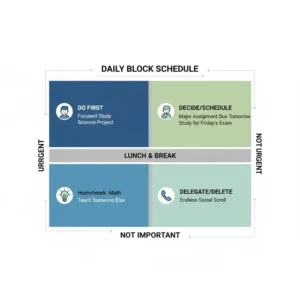
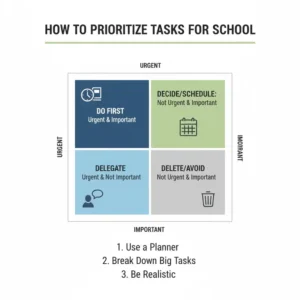
The Priority Matrix (The Filter): This step filters the master list into what must be done today. Many successful students use the Eisenhower Matrix (Urgent/Important) to determine their focus. Important tasks move to your daily agenda for students; Urgent and Important tasks get top priority.
-
The Time-Blocked Schedule (The Execution Plan): This is the core of your daily plan. As mentioned before, tasks are assigned specific time slots. This prevents time drift and ensures that essential activities, like attending class or studying for the MCAT, are protected.
-
The Reflection (The Feedback Loop): At the end of the day, you must review what you accomplished and what you missed. The Self Journal by BestSelf Co. is excellent for this. What went right? What distracted me? How can I improve my focus tomorrow? This self-assessment is key to continuous improvement. As one prominent source notes, “Self-reflection is the school of wisdom” (Source: Wikipedia – Self-reflection).
Secondary Keyword Deep Dive: Implementing the student daily scheduler
A student daily scheduler specifically emphasizes the time aspect of the agenda. The difference between a simple to-do list and a scheduler is the concrete placement of activities in time. You need to schedule not only your work but also your downtime and self-care.
-
Schedule Non-Negotiables First: This includes classes, fixed work shifts, and appointments. Block these out immediately.
-
Block Deep Work: Dedicate 2-3 hour blocks for focused, distraction-free study. During these times, phones should be off and notifications silenced. A tool like the Rocketbook Core Smart Notebook (Executive A5) is great here because it encourages a physical, focused activity rather than screen-based work.
-
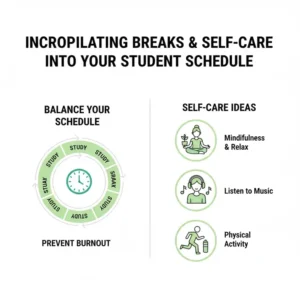
Schedule Rest and Transition: Seriously! Write down 12:30 PM – 1:00 PM: Lunch Break and 5:00 PM – 5:30 PM: Gym/Walk. These blocks are just as important as your study blocks to avoid burnout. A well-planned daily agenda for students is ultimately a plan for sustainable energy. For more detail on time management, check out high-authority academic sources on the topic (Source: Academic Time Management Resources from an Educational Institution).
Comparison Table 2: Budget vs. Premium Student Agenda Tools
When selecting your tool, the decision often comes down to cost versus the features you need. This table compares the value proposition across different price points.
| Product | General Price Range | Key Value Proposition | Primary Audience |
| Amazon Basics Weekly and Monthly Planner 2025 | $\$$ (Budget) | Low cost, simple, reliable structure. | High school students, very budget-conscious users. |
| Rocketbook Core Smart Notebook (Executive A5) | $\$\$$ (Mid-Range) | Hand-written feel with digital backup; highly reusable. | Practical students who want the best of both worlds. |
| The Self Journal by BestSelf Co. | $\$\$$ (Mid-Range) | Highly focused goal-setting and time-blocking methodology. | Users struggling with motivation, needing strict structure. |
| Passion Planner Classic (Undated) | $\$\$$ (Mid-Range) | Goal-integrated planning system; high-quality paper. | Students focused on long-term goals and personal development. |
| Moleskine Smart Writing Set (Pen+Ellipsis Notebook) | $$$$$ (Premium) | Automatic, high-quality transcription of notes and audio sync. | Students demanding superior quality and seamless digital conversion. |
| Apple iPad Air (5th Generation) with Apple Pencil 2 | $$$$$$ (High-End Tech) | Ultimate digital flexibility, versatility, and best-in-class note-taking apps. | Digital natives, design/art students, those replacing multiple devices. |
| Trello | $\$$ to $\$\$$ (Free-to-Premium) | Visual project management and collaboration features. | Group projects, highly organized, visual learners. |
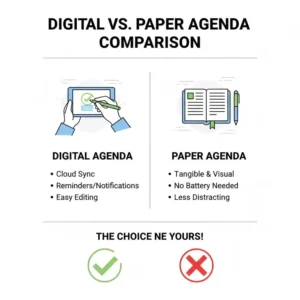
💡 Advanced Strategies for Organizing the daily agenda for students
Moving beyond the basic to-do list requires integrating advanced organizational techniques into your student daily schedule. The real goal is to turn frantic, reactive work into calm, proactive, and focused study.
Color-Coding and Visual Organization
Visual learners benefit immensely from organizing their student daily agenda with colors. This is easily done with the physical planners using highlighters or in a digital system like Trello using color-coded labels.
-
Red: Immediate/Urgent (Tests, Deadlines Today).
-
Blue: Class/Course Specific (Lecture notes, Required Reading).
-
Green: Personal/Wellness (Gym, Doctor Appointments, Social Events).
-
Yellow: Group Projects/Collaboration (Meetings, Shared Task Review).
When you look at your schedule, the color instantly signals the type of activity, allowing for quick mental prioritization. Even on a physical item like the Amazon Basics Weekly and Monthly Planner 2025, a simple four-color pen can revolutionize your planning.
The Power of the “Weekly Review”
While the term is “daily agenda for students,” the most effective planning is done weekly. Every Sunday (or a designated day), you should take 30-45 minutes to review the past week and plan the upcoming one.
-
Process Inbox: Clear out all loose papers, emails, and fleeting notes (e.g., in your Rocketbook Core Smart Notebook (Executive A5)) and file them or convert them into actionable tasks.
-
Review Goals: Check your long-term goals (especially if you use the Passion Planner Classic (Undated)). Are your daily actions still moving you toward your major academic and personal milestones?
-
Time Estimation: For every assignment, estimate the actual time it will take. Writing the essay outline might take 2 hours, not 30 minutes. Schedule that realistic time into your week, then break it into your daily agenda for students sections.
This weekly strategic session ensures that your daily actions are always aligned with your big-picture objectives, eliminating “busy work” that doesn’t actually contribute to your success.
Secondary Keyword Deep Dive: Selecting the Best student daily planner for college
The best student daily planner for college must handle a specific set of challenges: fluctuating schedules, multi-semester project tracking, and the need for portability.
-
Digital Versatility: For a busy college student, the digital option is often the strongest contender. The ability to instantly search through notes and sync with university calendars is invaluable. This is where tools like the Apple iPad Air (5th Generation) with Apple Pencil 2 shine because of the ecosystem integration.
-
Tactile Goal Alignment: If a student struggles with focus, a highly structured physical system, such as The Self Journal by BestSelf Co., may be the best student daily planner for college because its structure forces commitment and daily reflection, overcoming the digital distractions that plague many students. The choice is personal, but for college, you need a system that supports both flexibility and deep focus.
Further Reading: To deepen your understanding of effective study strategies and time management, consider exploring resources from reputable educational sources, such as university study skills centers (Source: Harvard University Strategies for Academic Success).
Comparison Table 3: Key Features and Benefits Comparison
This matrix compares the fundamental benefits and features across the recommended student agenda tools, providing a clearer picture of their core strength.
| Product | Primary Benefit | Goal Setting Integration | Note Transcription/Conversion | Best for Collaboration |
| Passion Planner Classic (Undated) | Strategic Goal Breakdown | High | None (Physical) | Low |
| Rocketbook Core Smart Notebook (Executive A5) | Instant Digital Backup of Handwritten Notes | Low | Scans to Cloud Storage | Medium (Sharing Files) |
| Amazon Basics Weekly and Monthly Planner 2025 | Uncluttered Simplicity and Low Cost | None | None (Physical) | Low |
| Moleskine Smart Writing Set (Pen+Ellipsis Notebook) | Seamless Hand-to-Digital Text Conversion | Medium | High (Accurate Transcription) | Low |
| The Self Journal by BestSelf Co. | Daily Commitment and Habit Building | High (13-Week Focus) | None (Physical) | Low |
| Apple iPad Air (5th Generation) with Apple Pencil 2 | Ultimate Digital Flexibility and Versatility | High (Via Apps like GoodNotes) | High (Via Apps) | High (Shared Documents) |
| Trello | Visual Project Tracking and Workflow | High (Custom Boards) | N/A (Digital Native) | Very High |
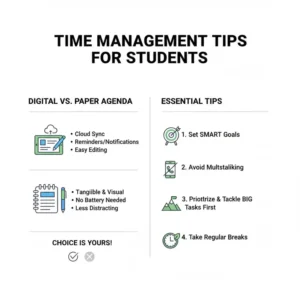
🤝 Making the daily agenda for students Work for You: Customization and Flexibility
No single system works for every single person. The most successful daily agenda for students is one that you actually use, and that means it has to be adaptable to your life. The rigidity of a pre-printed planner like the Amazon Basics Weekly and Monthly Planner 2025 might be perfect for some, while others need the infinite customizability of Trello.
Customizing Your Flow with Digital Tools
Digital tools excel at customization and adaptation. Using an application on the Apple iPad Air (5th Generation) with Apple Pencil 2 allows you to change your layout, insert images, annotate PDFs, and integrate with your university’s Learning Management System (LMS) calendar. For students with non-traditional schedules, like those with an internship or clinical rotations, the ability to instantly adapt the layout is essential.
Hybrid Agendas: The Best of Both Worlds
Many experts, including myself, advocate for a hybrid approach. This uses a physical planner, such as the Passion Planner Classic (Undated), for the planning (strategic thinking, goal setting, daily priorities) and a digital tool, like Google Calendar or Trello, for the details (reminders, file storage, collaborative tracking).
-
The Write-It-Down Advantage: The act of writing tasks into a physical student daily planner has been shown to improve memory retention. This is one reason why a tool like the Rocketbook Core Smart Notebook (Executive A5) is so compelling—you get the retention benefit of writing and the organizational benefit of digital backup.
-
The Digital Alert Advantage: No matter how disciplined you are, a digital alarm is the best defense against missing a key deadline. Your physical agenda tells you what to do; your digital reminder tells you when to do it.
Secondary Keyword Deep Dive: The Perfect daily agenda for college students
When we talk about the daily agenda for college students, we are talking about a system that must handle academic pressure while fostering independence. This is often the first time a young adult is fully responsible for their entire life schedule.
-
Financial Tracking: A college student’s agenda should also include space for simple budget tracking.
-
Wellness Check: Ensure your planner has a section for habit tracking—sleep, exercise, or meditation. The daily reflection in The Self Journal by BestSelf Co. is designed to address this holistic view of success. An effective daily agenda for college students must treat the student’s well-being as a priority, not an afterthought. You can’t focus on studying if you’re constantly exhausted or stressed.
Did You Know? Studies have shown that students who consistently use a detailed daily planner report significantly lower levels of stress and higher grade point averages compared to their peers who rely on memory or casual lists (Source: Educational Research on Student Planning and Performance).
Comparison Table 4: Features, Ratings, and Price Ranges
This final table provides a detailed comparison, incorporating user ratings (as a proxy for customer satisfaction) and general price positioning for a quick, informed decision.
| Product | Key Features | User Compatibility | Price Range |
| Passion Planner Classic (Undated) | Goal Mapping, High-Quality Paper, Monthly & Weekly Spreads | High (Best for long-term goal focus) | $\$\$$ |
| Rocketbook Core Smart Notebook (Executive A5) | Reusable Pages, Cloud Scanning, FriXion Pen Compatibility | High (Best for notes & quick drafts) | $\$\$$ |
| Amazon Basics Weekly and Monthly Planner 2025 | 12-Month Dated, Laminated Tabs, Simple Layout | Very High (Best for basic tracking) | $\$$ |
| Moleskine Smart Writing Set (Pen+Ellipsis Notebook) | Handwriting Transcription, Audio Recording Sync, Premium Aesthetic | Medium (Best for note-heavy lectures) | $$$$$ |
| The Self Journal by BestSelf Co. | 13-Week Time-Blocking, Daily Reflection, Goal Alignment | High (Best for strict focus/procrastination) | $\$\$$ |
| Apple iPad Air (5th Generation) with Apple Pencil 2 | M1 Chip, Versatile App Ecosystem, Digital Hand-Writing | Medium (Requires significant investment/setup) | $$$$$$ |
| Trello | Kanban Boards, Collaboration, File Attachment, Integrations | High (Best for visual organization/groups) | $\$$ to $\$\$$ |
🔥 Your Next Step to Success: Click to Shop! 🛒
Don’t wait for the next semester to start. The time to take control is now! Click the links in the table above to explore the Passion Planner Classic (Undated) or the innovative Rocketbook Core Smart Notebook (Executive A5) on Amazon and start building your ultimate daily agenda for students today. Your future self will thank you for taking this proactive step toward stress-free productivity!
🏁 Conclusion: Mastering Your Time with a daily agenda for students
Mastering your daily agenda for students is not about being busy; it’s about being effective. Whether you are a minimalist who only needs the basic tracking of the Amazon Basics Weekly and Monthly Planner 2025 or a digital powerhouse leveraging the Apple iPad Air (5th Generation) with Apple Pencil 2 ecosystem, the principle remains the same: Plan the work, and work the plan.
The journey to academic excellence is built on consistent, focused effort, and that effort begins with a clear, reliable student daily schedule. Use the structure we’ve outlined—the Master List, the Priority Matrix, the Time-Blocked Schedule, and the crucial Reflection—to transform your approach to school. By implementing these expert strategies and utilizing the right tools, you won’t just keep up with your assignments; you’ll gain the confidence and free time that comes from being truly in control of your academic journey.
❓ Frequently Asked Questions
✅ Digital planners are the most flexible, allowing easy reordering of tasks, collaboration, and instant searching. Apps used on tablets like the Apple iPad Air (5th Generation) offer infinite space and customizable layouts, making them ideal for complex, changing schedules where tasks need constant adjustment…
✅ Yes, research suggests the physical act of writing in a planner like the Passion Planner Classic (Undated) boosts memory retention and cognitive processing compared to typing. This is often due to the deeper encoding that occurs when forming letters by hand, making the information stick better…
✅ The Self Journal by BestSelf Co. is often considered the best for goal-setting college students. Its 13-week structure forces users to break major academic goals into small, measurable daily action items and includes built-in reflection to monitor progress and maintain accountability…
✅ Trello is an excellent, highly visual alternative for a student daily scheduler, especially for project-heavy coursework or group work. Its Kanban board structure allows for easy tracking of assignment progress (To Do, Doing, Done), providing a satisfying, clear overview of the academic workload…
✅ Undated planners, like the Passion Planner Classic (Undated), offer flexibility to start planning anytime and prevent wasted pages during breaks. Dated planners, like the Amazon Basics 2025 Planner, are simpler, requiring less manual setup, and are great for students with very predictable, semester-based schedules… ❓ What is the most flexible student daily planner format?
❓ Do physical planners like the Passion Planner improve memory more than digital ones?
❓ What is the best daily agenda for college students focused on goal-setting?
❓ Is Trello a good alternative to a traditional student daily scheduler?
❓ Should I choose an undated or dated planner for my daily agenda for students?
Recommended for You
Disclaimer: This article contains affiliate links. If you purchase products through these links, we may earn a small commission at no additional cost to you.
✨ Found this helpful? Share it with your friends! 💬🤗